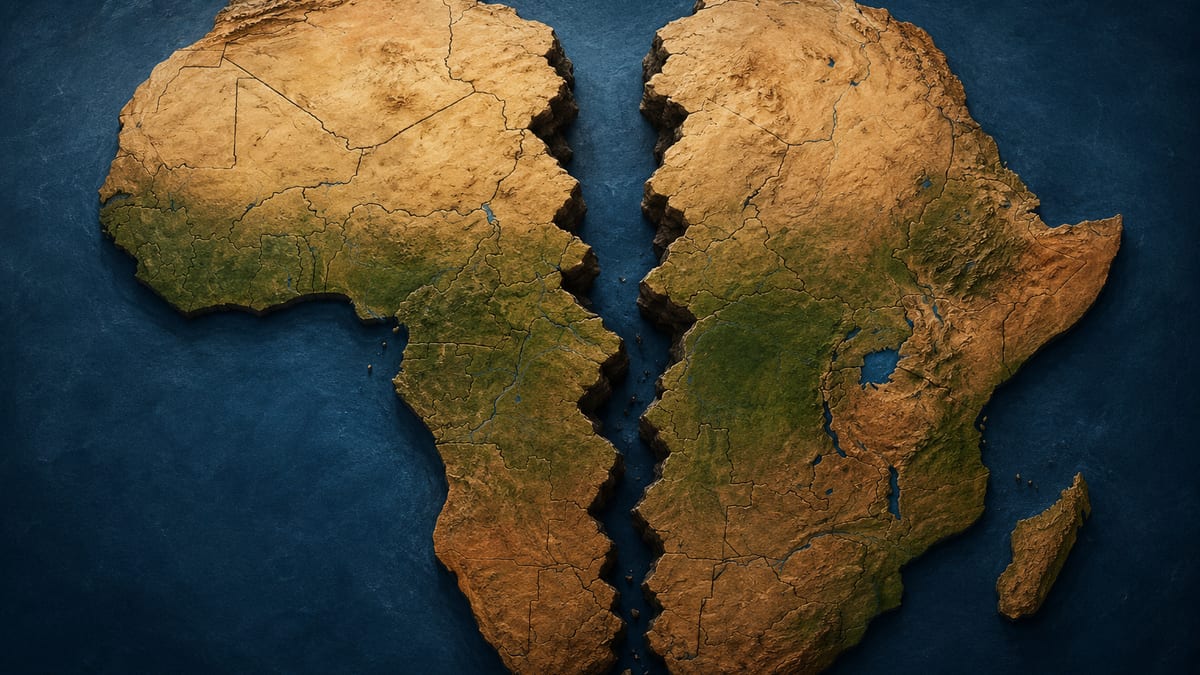
There is one thing that Julius Malema of South Africa and PLO Lumumba of Kenya have in common: they both crave for a united Africa, which is one of the few ideas that has emotional resonance across generations of Africans. A united Africa is a vision that has animated intellectuals, revolutionaries, and heads of state for well over a century and continues to find new voices with each generation. That idea touches themes of identity, dignity, and a shared memory of what colonialism did to the continent and its people. Africa united, if ever such a dream were to be achieved, could have far-reaching economic impacts not only in Africa but globally too. But despite the passion that the concept inspires, there are serious and grounded reasons to believe that a unified Africa, at least in the way it is most often imagined, is neither practical nor historically coherent.
The desire for African unity can be argued to have been born largely in the diaspora among Black intellectuals in the Americas and the Caribbean; blacks such as Marcus Garvey who looked at their shared condition of subjugation and saw a common cause. Garvey, the Jamaican-born publisher and activist, established the Universal Negro Improvement Association in the early twentieth century. He believed that people of African descent had a common heritage and a common struggle, and that the only way to achieve liberation was through collective solidarity. His Black Star Line shipping company was never a success, but it was partly an attempt to bring the African diaspora back to their ancestral homeland. That same sentiment is still alive today: Senegalese-American musician Akon has been one of the loudest celebrity voices promoting Pan-African solidarity, telling Al Jazeera that he has always felt Africa was for Africans and that the future of the continent lies within itself, and telling CAF Online that those who look outside the continent’s borders for opportunity are going in the wrong direction. W.E.B. Du Bois carried this same energy through a different channel, organising a series of Pan-African Congresses that brought together Black thinkers from around the world to discuss the political future of Africa and its people. These ideas travelled back to the continent and found eager audiences among a new generation of African leaders who were beginning to imagine life beyond colonial rule. Britannica’s entry on Pan-Africanism describes how, by the late 1940s, the intellectual energy of the movement had begun shifting from the diaspora to Africa itself, carried by future leaders who had absorbed its ideas while studying abroad.
Ghana’s first president after independence in 1957, Kwame Nkrumah, was the most forceful carrier of the banner of continental unity. Nkrumah had attended the 5th Pan-African Congress in Manchester in 1945, and from that point on, the idea of a unified Africa became the organising principle of his political life. In May 1963, he stood before thirty-one independent African heads of state gathered in Addis Ababa, Ethiopia, to form the Organisation of African Unity, and delivered what has since become one of the most quoted speeches in African political history. His words were stripped of all ambiguity: “We must unite now or perish.” He was calling for a full continental union, with shared foreign policy, a common defence, a single currency, and a Pan-African central bank. He argued that without unity, African nations would remain individually too weak to resist the economic and political influence of their former colonisers, and that what he called neocolonialism would simply replace direct colonial rule. South African History Online’s account of the OAU’s formation describes how the organisation that was eventually founded was a compromise, built on the principle of non-interference in member states’ internal affairs, and Nkrumah left Addis Ababa disappointed by its limited ambitions. He understood that coordination between sovereign states was a different thing from actual integration. The OAU was later reconstituted as the African Union in 2002, with a broader mandate that included economic integration, gender equality, and a stated principle of non-indifference to suffering within member states, but the fundamental tension between national sovereignty and continental solidarity never went away.
The economic case for African unity is a very strong one. Africa is endowed with vast mineral and agricultural resources, but the countries of the continent individually lack the market size, the bargaining power, and the infrastructure to turn that wealth into lasting development. Some idea of what greater integration might offer is provided by the African Continental Free Trade Area, which officially started trading in 2021. A World Bank study found that if the trade pact is fully implemented, the combined income of African countries could increase by about seven per cent, or approximately 450 billion dollars by 2035, and help to lift tens of millions of people out of poverty. The agreement links 1.3 billion people across 55 countries with a combined GDP of approximately 3.4 trillion dollars, making it the largest free trade area in the world by number of countries involved. African countries currently trade more with the rest of the world than with each other, and supply chains, manufactured goods, and even food often pass through Europe or Asia before reaching a destination across the continent. A more integrated Africa could fix that. The political argument runs along similar lines: a group of 55 countries speaking with a single voice on international trade, climate negotiations, or debt relief carries considerably more weight than 55 countries negotiating individually. These are real points, and they are the reason the dream of unity has never faded.
But that is where the conversation usually goes quiet, because the most fundamental problem with the unity argument is also the most uncomfortable to say aloud. Africa was never one people to begin with. The notion that colonialism shattered some pre-existing continental solidarity is a myth. At the time of the Berlin Conference of 1884-85, when European powers carved up the continent without a single African present at the table, Africa was a vast landmass with hundreds of different kingdoms, empires, ethnic groups, religions, and languages, many of which had conflicted with one another for centuries. The Bantu expansion was the migration of peoples from a nucleus around present-day Cameroon across Central, Eastern, and Southern Africa over thousands of years, displacing and absorbing earlier populations such as Khoisan and Pygmy groups as Bantu-speaking communities moved into territories that were already occupied. Britannica reports that there are more than 1,500 distinct African languages, organised into several completely separate families, among them Niger-Congo, Afroasiatic, and Nilo-Saharan. The Harvard African Language Program puts the total range at anywhere between 1,000 and 2,000 languages, accounting for about a third of all languages spoken on earth. More than 520 of them are found in Nigeria alone. Based on the Ethnologue index of linguistic diversity, twenty of the twenty-five most linguistically diverse countries in the world are in Africa. That level of diversity reflects thousands of years of separate development, separate migrations, and separate political histories.
Wars between kingdoms, ethnic raids, territorial disputes, and what we would now call forced displacement of entire communities are common features of pre-colonial African history. In the late seventeenth century, the Asante empire expanded, pushing Akan peoples into neighbouring territories. In the early nineteenth century, the Zulu kingdom under Shaka launched the Mfecane, a period of intense warfare across Southern Africa that destroyed entire communities and displaced populations over a vast area. The Mali Empire, the Songhai Empire, the Kingdom of Kongo, and the Oyo Empire were all powerful states, and they were powerful precisely because they expanded at the expense of their neighbours. Research published in the journal International Organisation found that ethnic groups organised as pre-colonial states contributed significantly to post-colonial violence and instability, as historically rooted advantages allowed certain groups to dominate state power while excluding others. The point is that Africa was, and has always been, far more like Europe or Asia than like a single nation waiting to rediscover itself. A Europe that was divided into competing empires for centuries before producing the modern European Union did not accomplish that union by pretending the divisions never existed. It took decades of careful, incremental institution-building, and even then, the EU remains a frequently fractious arrangement of sovereign states that retain enormous autonomy. Africa, with its far greater cultural, linguistic, and religious diversity, faces that same challenge on a much larger scale.
There is also a counterintuitive point worth sitting with: the current arrangement of African nation-states may actually represent the closest the continent has come to a workable, organised coexistence across its full geographic range. The colonial borders, for all their arbitrary brutality, created administrative units that over time have developed their own national identities, institutions, and loyalties. Nairobi residents feel more Kenyan than African. The residents of Accra consider themselves Ghanaian. That is the natural product of shared governance, shared public life, and shared national history across several generations. To dissolve those identities into a continental superstate would replace one form of top-down reorganisation with another, and there is no particular reason to believe the second reorganisation would go better than the first.
Apart from the historical and cultural objections, there is a very practical problem with the idea of a unified Africa that allows free movement and settlement across the entire continent. Right now, without any formal continental open-borders policy, the movement of people from poorer and more unstable parts of Africa toward the more stable and economically productive parts is already straining the receiving countries. South Africa is the most obvious case in point. As Africa’s most developed economy, it draws migrants from Zimbabwe, Mozambique, the DRC, Nigeria, and elsewhere, pulled by better wages, better services, and relative stability. South Africa’s president, Cyril Ramaphosa, acknowledged in 2026 that this migration was placing pressure on already stretched public health systems, schools, and housing. The mayor of Johannesburg, in evidence to parliament, described how undocumented migration had compounded serious challenges in service delivery and contributed to overcrowding in a city that already had a housing backlog of an estimated 300,000 units. Anti-immigration sentiment has become a regular part of South African public life, and xenophobic attacks on foreign nationals from across the continent have become alarmingly frequent. Al Jazeera reported in May 2026 that human rights organisations were warning of a new wave of such attacks as anti-immigration groups intensified protests and vigilante-style actions in Johannesburg, Pretoria, and Durban. The rest of the continent faces the same pressures whenever stability in neighbouring states breaks down, and relatively prosperous cities and countries are no exception. Scale that pressure up to universal free movement across all 55 African countries, and the flow of people toward functioning cities and economies would be vast, more than enough to overwhelm the infrastructure that makes those cities attractive in the first place.
And then there are the ongoing conflicts that make the question of continental unity feel almost theoretical when you look closely at the map. The Democratic Republic of Congo, the second-largest country in Africa by land area and home to some of the world’s most valuable mineral deposits, has been plagued by near-continuous armed conflict for more than two decades. The UNHCR reported that by September 2025, 8.2 million people had been displaced within the country, a figure projected to reach 9 million by the end of 2026. Human Rights Watch’s 2024 DRC country report documented the Rwanda-backed M23 armed group forcing more than half a million people from their homes in North Kivu alone, pushing the country’s total displaced population to nearly 7 million, the highest number of internally displaced people anywhere in Africa. In the Sahel, Mali experienced coups in 2020 and 2021, Burkina Faso had two coups in 2022, and Niger had one in 2023. The United States Institute of Peace noted that Burkina Faso, Mali, and Niger subsequently formed their own Alliance of Sahel States and withdrew from ECOWAS in January 2025, fracturing the very regional body that was supposed to hold West Africa together. The UN Security Council Report on the Sahel observed that entire communities had been emptied across northern Mali and western Niger as violence between armed groups, intercommunal clashes, and military activity continued to spread. In Somalia, the UNDP describes a country where the state-building process is still ongoing, where there is not yet an accepted model for how power and resources are shared between the federal government and its member states, and where around 3.8 million people remain internally displaced, congregating around major cities in one of the fastest urbanising trends in the world.
All of this must be confronted in any sincere vision of African unity. It has to explain what happens when you attempt to build a continental government that includes a DRC where millions are displaced and where armed groups operate with near-total impunity alongside a Rwanda accused of backing those same armed groups, alongside a Burkina Faso run by a military junta that extended its own transition to civilian rule by five more years in 2024, alongside a South Africa that cannot currently manage the pressures of regional migration on its own cities. It has to account for what a common foreign policy looks like across countries with such radically different political systems, such different relationships with former colonial powers, and such different immediate security priorities. It has to explain why governance at the continental level would be easier than it already is at the national level, when it is already so difficult at the national level. The African Union, the AfCFTA, the regional economic communities, and the various peacekeeping frameworks that already exist represent the real, incremental work of integration. That work matters and deserves to be supported. The vision of a continent-wide political union, though, is built on the premise of a shared African identity that colonialism disrupted, and that premise asks us to accept a unity that, if we are honest about the historical record, was never quite there to begin with.