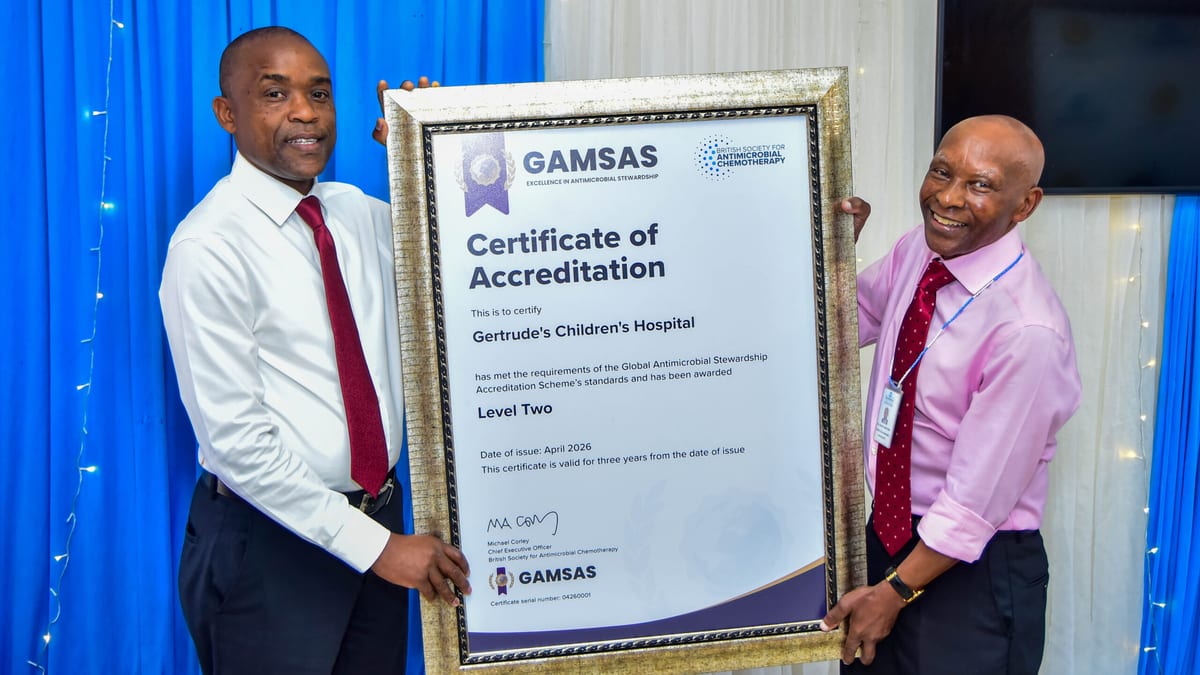
Kenya urged to scale up antimicrobial stewardship as Gertrude’s Children’s Hospital secures global accreditation after becoming the first hospital in the country to receive international recognition for promoting the responsible use of antibiotics.
The hospital has been awarded the Global Antimicrobial Stewardship Accreditation (GAMSAS) by the British Society for Antimicrobial Chemotherapy (BSAC). The award recognizes hospitals that meet high international standards in ensuring antibiotics are used responsibly to protect patients and slow the spread of antimicrobial resistance (AMR).
Speaking after receiving the accreditation, Gertrude’s Children’s Hospital Chief Executive Officer, Dr. Robert Nyarango, said the achievement reflects the hospital’s commitment to improving patient care and supporting Kenya’s fight against antimicrobial resistance.
“We are proud to be the first healthcare institution in Kenya to receive this accreditation. It shows our commitment to using antibiotics responsibly to ensure they remain effective for future generations,” said Dr. Nyarango.
He also called on hospitals, healthcare workers, policymakers, and patients to work together to reduce the misuse and overuse of antibiotics, which is one of the leading causes of antimicrobial resistance.
Antimicrobial resistance happens when bacteria, viruses, fungi, and other germs change over time and stop responding to medicines that once killed them. As a result, infections become harder to treat, increasing the risk of severe illness and death.
According to The Lancet, antimicrobial resistance directly caused about 1.27 million deaths worldwide in 2019 and contributed to nearly 5 million deaths. In Kenya, the Institute for Health Metrics and Evaluation estimates that about 28,500 deaths have been linked to antimicrobial resistance.
Dr. Joseph Mbuthia, a paediatric infectious disease specialist and Chairperson of the hospital’s Antimicrobial Stewardship Committee, said AMR is becoming a major public health challenge in Kenya, affecting people, animals, and the environment.
“This achievement shows that healthcare institutions have an important role to play in protecting antibiotics and improving patient safety,” he said.
To reduce unnecessary antibiotic use, the hospital introduced strict prescribing rules in 2019. Some powerful antibiotics, antivirals, and antifungal medicines can only be used after laboratory tests confirm they are needed or with approval from an infectious disease specialist.
These efforts have led to significant improvements. Compliance with antimicrobial stewardship standards increased from 66 percent in 2020 to 94 percent in 2025. At the same time, adherence to standard treatment guidelines rose from 50 percent in 2022 to 86 percent in 2025.
The hospital says the accreditation supports Kenya’s National Action Plan on Antimicrobial Resistance, which aims to improve public awareness, strengthen disease surveillance, prevent infections, and promote the responsible use of antimicrobial medicines.
Health experts say stronger antimicrobial stewardship across all healthcare facilities will help preserve the effectiveness of life-saving antibiotics and protect the health of future generations.