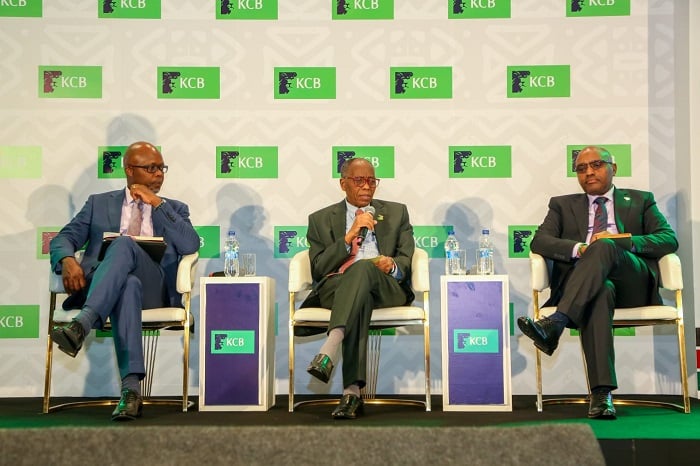
KCB Group delivered what many investors would consider a strong set of Q1 2026 results. Profit before tax rose 15.3% to KShs. 24.4 billion, customer deposits surged, and the bank continued to expand its regional footprint. Yet buried inside the earnings release was one of the most important signals about the Kenyan economy today: declining net interest margins (NIMs).
Management acknowledged that sustained rate cuts by regulators across the region had reduced asset yields and pressured margins. In simple terms, KCB is earning less money from each loan it issues. For a bank, that matters because margins are the engine of profitability.
But the deeper question is this: if Kenyan borrowers are still paying some of the highest lending rates in the region, why are banks already complaining about margin pressure?
That contradiction reveals a bigger structural problem in Kenya’s financial system.
The Kenyan Borrower’s Reality
For years, Kenyan households and businesses have complained that credit remains too expensive despite repeated calls for monetary easing. Even when benchmark rates fall, the reduction rarely translates into meaningfully cheaper loans for ordinary borrowers.
Small businesses still struggle to access affordable working capital. Mortgage penetration remains extremely low. Consumer lending remains expensive. Many SMEs continue relying on mobile loans and informal credit because traditional bank financing is either inaccessible or prohibitively costly.
This creates an uncomfortable disconnect:
- Regulators believe rates are easing.
- Banks say margins are shrinking.
- Borrowers still feel money is extremely expensive.
All three can technically be true at the same time.
Banks may be experiencing lower yields relative to previous years, but the absolute cost of borrowing in Kenya remains high compared to income levels and regional peers. A reduction from very high rates does not necessarily make credit affordable.
Why High Lending Rates Are Hurting Credit Growth
One of the more revealing comments in KCB’s release was management’s warning about “depressed credit demand.”
Weak credit demand is not only a result of geopolitical uncertainty or global economic risks. It is also a reflection of the domestic cost of money.
When lending rates remain elevated:
- businesses postpone expansion,
- households avoid borrowing,
- investment slows,
- and consumption weakens.

Eventually, banks themselves feel the consequences through slower loan growth.
This creates a cycle where:
- High rates reduce borrowing appetite.
- Lower borrowing weakens economic activity.
- Banks compete aggressively for fewer quality borrowers.
- Margins compress further.
In that environment, protecting profitability through high spreads becomes increasingly unsustainable.
KCB’s Strategic Dilemma
KCB’s results show that the bank is still growing largely through balance sheet expansion. Loans increased, deposits increased, and operating income continued rising. But the quality of that growth deserves scrutiny.
The bank also disclosed:
- elevated provisioning for bad loans,
- still-high non-performing loans,
- and ongoing economic risks.
That suggests borrowers are already under pressure.
If businesses and households are struggling to service existing loans, maintaining expensive credit conditions may worsen asset quality over time. Banks could end up defending short-term margins while damaging long-term loan performance.
This is why the debate around lower rates is no longer just about consumer relief. It is becoming a banking sector sustainability issue.
Should Banks Push Harder for Lower Rates?
There is an argument that large banks like KCB should be more aggressive in supporting deeper rate reductions and broader credit affordability reforms.
Lower borrowing costs could:
- stimulate private sector growth,
- increase credit uptake,
- improve SME activity,
- strengthen household spending,
- and expand the long-term lending market.
In other words, banks may earn less per loan, but potentially make more money through higher transaction volumes and healthier economic activity.
This is the classic tradeoff between:
- high-margin, low-volume lending,
- versus lower-margin, high-volume lending.
Kenya’s economy arguably needs the second model more urgently.
The Bigger Risk for Kenyan Banks
The real long-term threat may not be shrinking NIMs alone.
It may be the gradual weakening of traditional bank lending as businesses and consumers search for alternatives:
- fintech lenders,
- SACCOs,
- private credit,
- embedded finance platforms,
- and regional digital banks.
If formal banking remains too expensive, customers eventually adapt around the banking system.
That could erode the dominance of large commercial banks over time.
Final Thought
KCB’s earnings highlight an important reality: profitability pressure is beginning to collide with Kenya’s affordability crisis.
Banks are warning about weaker margins while borrowers continue struggling with the high cost of credit. That tension cannot persist indefinitely.
The next phase of banking growth in Kenya may depend less on defending high lending spreads and more on unlocking affordable credit that expands the overall economy.
Because ultimately, sustainable banking profits come from a growing economy — not just expensive loans.