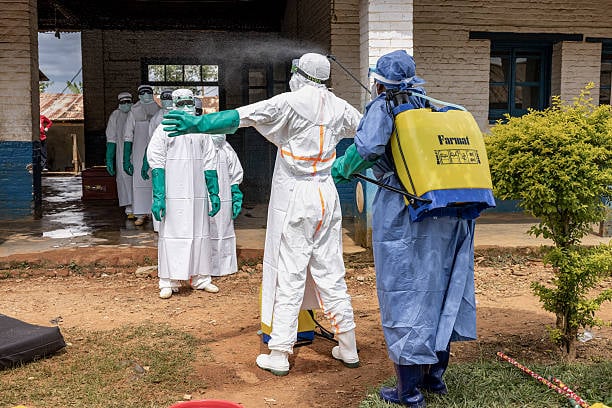
There is a quarantine facility at the centre of a political and legal storm in Kenya before it has even opened. The US government, working with President William Ruto’s administration, planned to establish an Ebola quarantine facility at Laikipia Airbase for Americans exposed to Ebola during the outbreak in the Democratic Republic of the Congo. The US committed $13.5 million toward Kenya’s Ebola preparedness as part of a broader $112 million regional response.
The proposal quickly faced resistance. A High Court judge suspended the project, civil society groups protested, doctors raised concerns, and the Katiba Institute sued, arguing the agreement lacked public participation, parliamentary oversight, and constitutional transparency. As a result, the facility now sits in legal limbo.
Much of the public reaction was driven by a misunderstanding of what was being proposed. The 50-bed facility was not intended for sick Ebola patients. It was designed to house asymptomatic individuals who had been exposed to the virus but had not developed symptoms. If symptoms emerged, patients would be transferred to higher-level biocontainment facilities elsewhere, primarily in Europe. The site would be staffed by trained members of the US Public Health Service and backed by significant American funding and expertise.
Beyond the immediate outbreak, the facility could leave lasting benefits for Kenya. It would add infrastructure, equipment, trained personnel, operational protocols, and public health expertise that could strengthen preparedness for future outbreaks. Kenya had already intensified Ebola preparedness after cases appeared in Uganda in 2025, activating emergency response structures and investing in prevention measures. A modern isolation facility would fit naturally within that strategy.
The facility could also serve as a training centre for Kenyan health workers, a model for regional outbreak response, and infrastructure adaptable to future threats such as Marburg, Mpox, or Rift Valley Fever. Given Kenya’s position as a regional transport and health hub, such capacity has strategic value.
Critics argue that bringing Ebola-exposed individuals into a country without active Ebola cases creates unnecessary risk. That concern deserves attention, but the actual risk was lower than public debate often suggested. Ebola spreads through contact with bodily fluids from symptomatic patients. Individuals who are exposed but asymptomatic are not contagious in the same way. The purpose of quarantine is precisely to monitor such individuals in a controlled setting. Located on a military base and staffed by specialised personnel, the facility would have multiple layers of containment. While no system is risk-free, public fears often reflected worst-case assumptions rather than the design itself.
Kenya was also a logical choice from a logistical perspective. Nairobi’s connectivity, distance from the outbreak zone, relatively strong infrastructure, and stable partnership with the United States made it more practical than either the conflict-affected eastern DRC or neighbouring Uganda, which was already managing confirmed cases. Hosting the facility could also deepen US-Kenya cooperation through investment, technology transfer, and specialised training.
The biggest failure was communication. US officials framed the project primarily as a way to prevent Ebola from reaching the United States. Statements from Secretary Marco Rubio and other officials focused on protecting Americans. Although factually accurate, this messaging implied that risks unacceptable for Americans were acceptable for Kenyans. That was not what the facility’s design actually proposed, but it was the impression many people received.
The US had stronger arguments available: the impracticality of long-distance medical evacuations, instability in eastern DRC, Uganda’s proximity to the outbreak, Kenya’s preparedness, and the long-term regional value of the infrastructure. Had officials emphasised those points and openly involved Kenyan institutions and the public, the proposal may have been viewed as a partnership rather than an imposition.
The lawsuit by the Katiba Institute reinforced concerns about secrecy and constitutional process. Critics, including some former public health officials, further argued that Kenya lacked the highest level of biocontainment facilities, feeding perceptions that the country was being asked to accept risks the United States would not.
At its core, the controversy is not simply about Ebola. It is about transparency, sovereignty, and respect. The proposed facility addressed a genuine regional public health gap and came with significant funding and expertise. What it lacked was a communication strategy that clearly explained why Kenya was chosen and how Kenya itself would benefit. A potentially valuable partnership became politically toxic because the rationale was presented through the lens of American protection rather than shared regional health security.