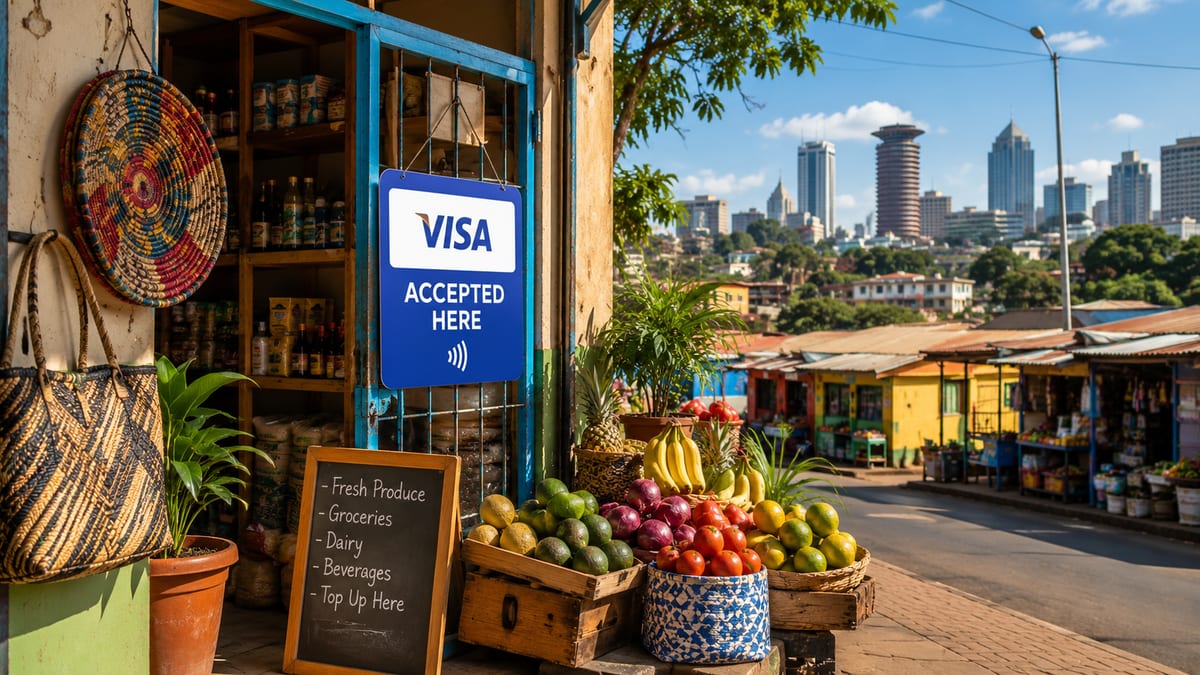
Kenya has earned its reputation as Africa’s Silicon Valley, yet when it comes to digital payments, the country never really followed the Western playbook. In the West, digital payments grew out of banking and card infrastructure, built around an account, a card tied to it, and a terminal made to read that card. Kenya took a different route entirely, skipping past much of that card-heavy history and building its financial habits around mobile money instead. That is why many small and medium businesses today send and receive money straight from a phone rather than through a card machine.
A business in Nairobi, for instance, might run its entire day-to-day cash flow through M-Pesa, paying suppliers, receiving customer payments, and settling small debts with neighbouring traders, without a bank card ever entering the picture. Commerce has worked this way for a large share of Kenya’s SME sector for years now, well before anyone spoke of digital transformation or fintech partnerships. What is changing, and changing quickly, is how digital payments in Kenya are folding card acceptance into that same mobile experience, letting the phone in a trader’s pocket also tap and accept a Visa card.
Two payment cultures that grew up separately are now starting to meet in the middle of Kenya’s small business economy. The Western model assumed a fairly rigid sequence of steps, whereby a bank account had to exist before a card could be issued. A card, in turn, could only be issued once a terminal was ready to process it. Kenya’s mobile money system matured faster than its card infrastructure ever did, so the smartphone became the financial tool of choice long before card acceptance reached small traders. What is unfolding now, through partnerships between Visa and Kenyan banks, extends that same smartphone into card acceptance territory instead of replacing the mobile habits people already trust.
For most small business owners, the real obstacle to accepting cards was cost rather than any reluctance to embrace new payment methods. Traditional point-of-sale machines needed upfront capital, ongoing servicing, and contracts that made more sense for a supermarket chain, a hotel, or a large retail outlet than for a kiosk or a single market stall. A trader without that kind of capital simply stayed cash-only, or asked customers to send money through mobile transfer instead, which worked fine until a customer’s only payment method happened to be a card. Digital payments in Kenya have started closing that gap by removing the need for separate hardware altogether, rather than by making POS machines any cheaper.
None of this shift has come from a single company acting alone, since it rests on a handful of separate bank and technology partnerships. Absa’s Mobi Tap lets a business accept card payments directly through an Android phone, so that a merchant can download the app, set up a profile, and start taking payments within minutes rather than weeks. KCB Bank’s Tap to Phone solution runs on the Visa Acceptance Platform and uses tokenisation to keep each transaction secure, aimed squarely at SMEs long priced out of conventional POS equipment. Co-operative Bank has rolled out its own version through the Visa Accept solution, extending the same category of acceptance to its business banking customers. Even Kenya’s tourism sector carries its own version of this shift, since Craft Silicon’s TouristTap turns NFC-enabled phones into certified payment devices for safari operators, lodges, and curio traders along the tourist circuit. Different banks and different partners are building toward the same underlying idea, putting acceptance on top of infrastructure businesses already own instead of infrastructure they would have to buy.
The practical effect of this shift is fairly easy to see in daily transactions across the country. A shop that once had to turn away a card-only customer, or send them searching for an ATM, can now process that payment on the spot. That single tap captures a sale that would otherwise have simply walked out the door. Every transaction also leaves behind a digital record automatically, which matters well beyond the moment of sale itself. That record can support inventory decisions, cash flow tracking, and loan applications, since a documented sales history tends to carry more weight with lenders than a notebook of cash tallies ever could. There is a security angle worth mentioning too, since less physical cash sitting in a till throughout the day means less exposure to theft. That matters a great deal for a small trader who lacks the kind of security setup a larger retailer might have.
This pattern shows up across many types of business, including retail shops, service businesses like salons and repair shops, and tourism operators along the coast and safari circuit. Tourism, in particular, relies on tools built around a specific reality, since international visitors are far more likely to carry a card than local currency. Whether the setting is a Nairobi kiosk, a coastal curio shop, or a safari lodge, digital payments in Kenya are shaped by what a smartphone can do.
The businesses standing to gain the most from this shift also happen to be the ones that have historically sat furthest from formal banking and finance. That group includes women-led businesses, informal traders operating without registered structures, and younger entrepreneurs just getting a venture off the ground. For many of these groups, removing the upfront cost and hassle of hardware becomes a genuine first step into the formal digital economy, complete with the transaction history and credibility that come with it.
Kenya skipped the Western sequence of banks, cards, and terminals, building something of its own instead: a mobile-first financial system that most of its population already trusts and uses daily. What is happening now, as card acceptance layers onto that same mobile infrastructure, amounts to two systems meeting in the middle rather than one replacing the other. For Kenya’s SME sector, that meeting point may matter more than either system would have mattered on its own. It stretches the trust already built around mobile money far enough to also accept the card-based payments that global commerce has long assumed as standard. As digital payments in Kenya continue moving in this direction, businesses adapting early are simply accepting payment however a customer prefers to pay, using the device they already carry.