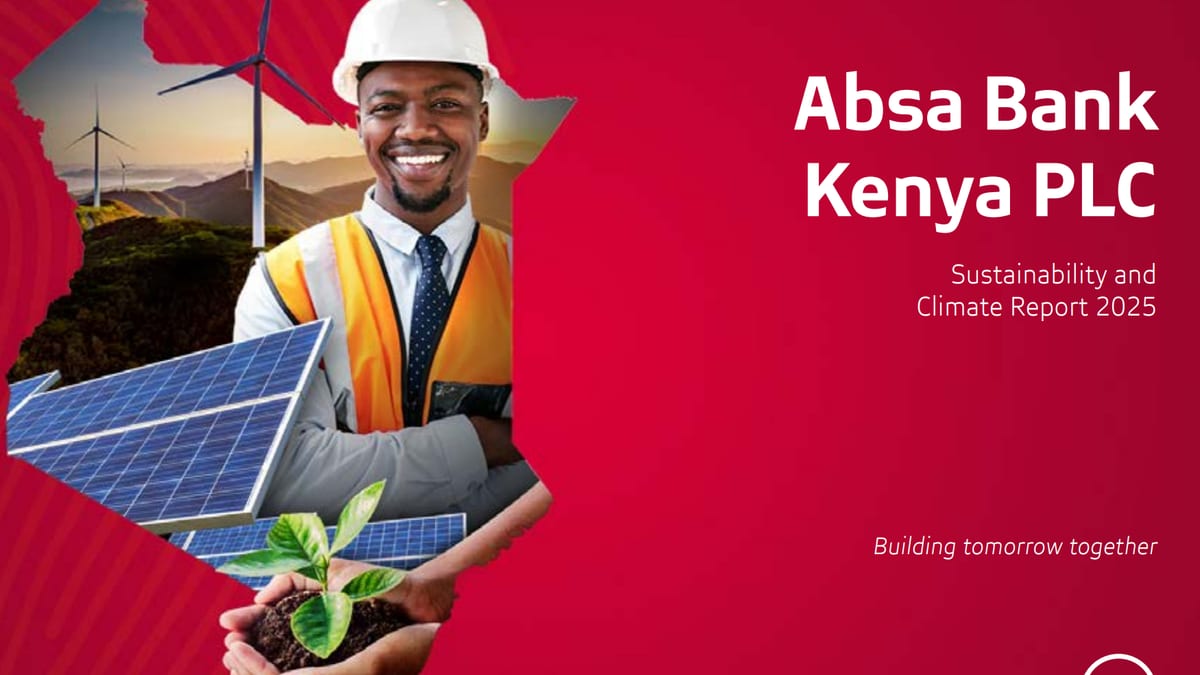
Absa Bank Kenya’s newly released 2025 Sustainability and Climate Report lays out exactly where more than KES 204 billion went between 2022 and 2025, and the 2025 figures alone tell a fairly detailed story on their own. The bank disbursed KES 55.3 billion in 2025, up from KES 47 billion in 2024, and that money split across a handful of clear priorities: small businesses, women-led enterprises, youth entrepreneurship, affordable housing, renewable energy, and climate-smart agriculture.
The largest single share, KES 48.8 billion, went toward financial inclusion financing aimed at SMEs, women-owned businesses, young entrepreneurs, and underserved communities. For a lot of entrepreneurs in Kenya, access to affordable financing remains one of the biggest obstacles to growing a business, so directing this much money toward that gap has a direct effect on job creation and household incomes across the country. Speaking at the report’s launch at Strathmore University, Yusuf Omari, Absa Bank Kenya’s Interim Managing Director and CEO, said the bank’s sustainability journey has been guided by a deliberate effort to create shared value for customers, communities, and the wider economy, adding that capital was deployed intentionally into supporting business growth, affordable housing, climate-smart agriculture, renewable energy, and broader financial inclusion.
Alongside the inclusion financing, Absa allocated KES 6.5 billion to climate finance, covering renewable energy, green buildings, energy efficiency, and climate-smart agriculture. This spending pattern lines up with a shift in how people and businesses are already making decisions, since sustainability increasingly shapes how homes get built, how businesses power themselves, and how farms are managed. The bank’s eligible sustainable finance allocation reached 30% of its gross loan disbursements for the year, well past its original 10% target set for 2025.
Money also went into reducing the bank’s own environmental footprint rather than just financing outside projects. In 2025, Absa planted 283,969 trees, compared to 72,000 in 2024, pushing its cumulative total past 1.5 million. It reached a 96.4% waste recycling rate and cut its own operational energy consumption by 41%, spending that reflects a growing expectation that companies should not only fund sustainability projects for others but also clean up their own operations.
A separate portion of spending went into people rather than projects. Through the ReadytoWork programme, nearly 38,000 young people received employability and entrepreneurial skills training in 2025, bringing the total number of beneficiaries past 300,000 young Kenyans since the programme started. The Absa Kenya Foundation added to this work in education, skills development, entrepreneurship, and natural resource management, reaching more than 50,000 individuals during the year.
Dr. Festus Ng’eno, Principal Secretary in the State Department for Environment and Climate Change, attended the launch and commended Absa for its role in advancing private-sector climate action, noting that climate change is already affecting livelihoods, infrastructure, ecosystems, and economic productivity. He said the cost of inaction keeps rising, which makes climate investment both an environmental necessity and a sound economic decision.
Some of the spending went toward systems rather than direct financing. Absa’s enhanced disclosures now align with the International Sustainability Standards Board framework, including IFRS S1 and IFRS S2, a shift that strengthens confidence among investors, customers, and development partners in how the bank manages sustainability and climate-related risks.
Having completed its 2021 to 2025 Sustainability Strategy, Absa has now set a new one built around four goals: accelerating sustainable finance growth, reaching net-zero emissions by 2050, strengthening sustainability risk management and governance, and embedding sustainability into the bank’s culture and customer experience. It aims to keep at least 30% of gross loan disbursements in financial inclusion, green finance, and nature-based finance going forward.
For everyday Kenyans, this spending translates into fairly concrete outcomes: entrepreneurs get better access to financing for growth, women and youth get more support to start and scale businesses, homeowners and developers get more financing options for energy-efficient and affordable housing, farmers get funding for climate-smart practices that improve productivity, and communities benefit from investment in skills development and environmental conservation.
The full sustainability report is available on Absa Bank Kenya’s website.