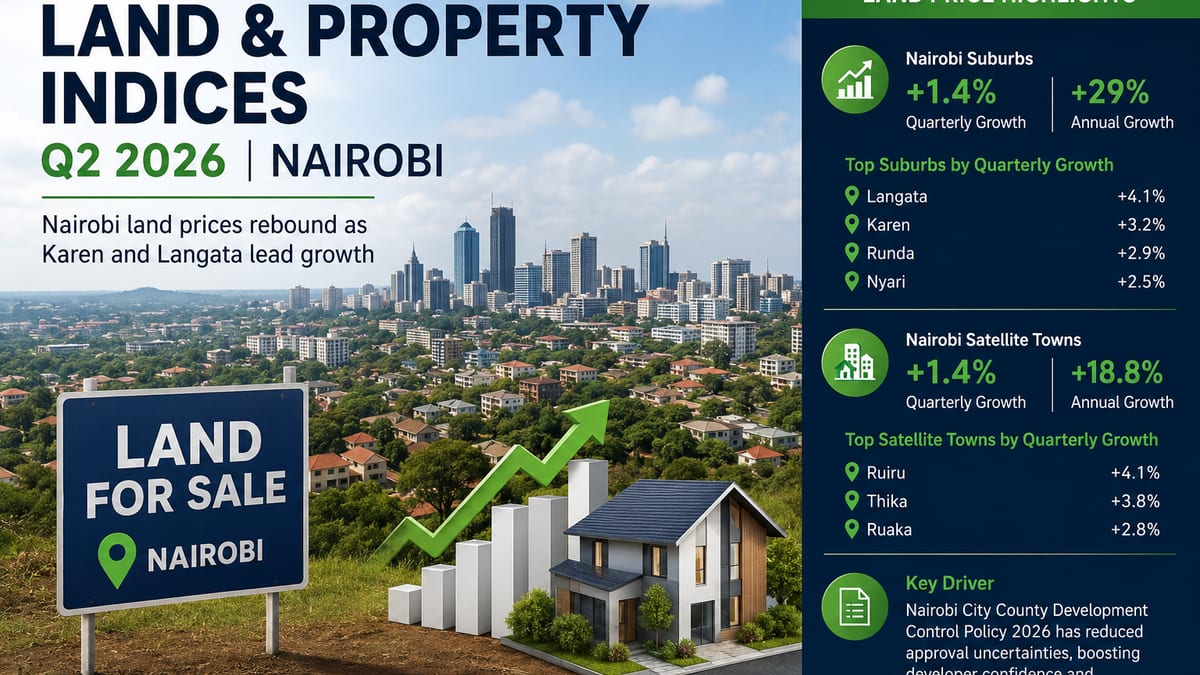
HassConsult Land and Property Indices Q2 2026 show that land prices in Nairobi’s suburbs increased by 1.4 percent in the second quarter of 2026, up from the 0.8 percent growth recorded in the previous quarter.
The increase shows that demand for land is picking up again, especially in areas where buyers and developers can find opportunities for residential development.
Langata and Karen Lead Nairobi’s Land Price Growth
Langata recorded the highest quarterly increase, with land prices rising by 4.1 percent to about KSh94.7 million per acre.
Karen followed with a 3.2 percent increase, bringing the price to about KSh79.5 million per acre. Runda recorded a 2.9 percent rise to approximately KSh105.6 million per acre, while Nyari increased by 2.5 percent to about KSh128.2 million per acre.
According to HassConsult, demand has increasingly shifted towards areas such as Karen and Langata, where land is relatively more affordable compared to some other high-end Nairobi suburbs. The demand is mainly coming from developers and individuals looking to build detached and semi-detached homes.
Karen also recorded its strongest annual growth in a decade, with land prices increasing by nearly 10 percent over the past year.
New Development Policy Supports Demand
The recovery in land prices has also been linked to the recently published Nairobi City County Development Control Policy 2026.
The policy has helped reduce some of the uncertainty around planning and development approvals. This has encouraged developers who had previously delayed new projects while waiting for clearer guidelines.
Satellite Towns Also Record Growth
Land prices in Nairobi’s satellite towns also increased by 1.4 percent during the second quarter, compared with only 0.5 percent in the previous quarter.
Ruiru recorded the strongest growth, with land prices rising by 4.1 percent to about KSh42.2 million per acre.
Thika followed with a 3.8 percent increase to approximately KSh32.4 million per acre, while Ruaka recorded a 2.8 percent increase to about KSh115.7 million per acre.
However, not all satellite towns experienced growth. Seven of the 14 towns covered by the index recorded declines. Ngong had the biggest drop at 2.5 percent, followed by Limuru at 0.8 percent.
Why Ruiru, Thika and Ruaka Are Growing
Ruiru’s land market continues to benefit from major mixed-use developments such as Tatu City and Northlands. These developments are attracting workers and businesses, increasing demand for housing and land.
In Thika, the town’s expected elevation to city status is helping attract attention from investors who anticipate increased development and investment.
Meanwhile, Ruaka has benefited from the completion of the Nairobi Western Bypass and its location near the UN Blue Zone, which have increased demand for residential housing.
What the Report Means for Buyers and Investors
The latest figures show that Nairobi’s land market is recovering, but growth is not happening equally everywhere.
Areas with strong infrastructure, employment opportunities, commercial activity and residential demand are attracting more buyers and investors.
For people looking to buy land, develop property or invest in real estate, the report highlights the importance of looking beyond location alone and considering the economic activities and infrastructure that can drive future land demand.