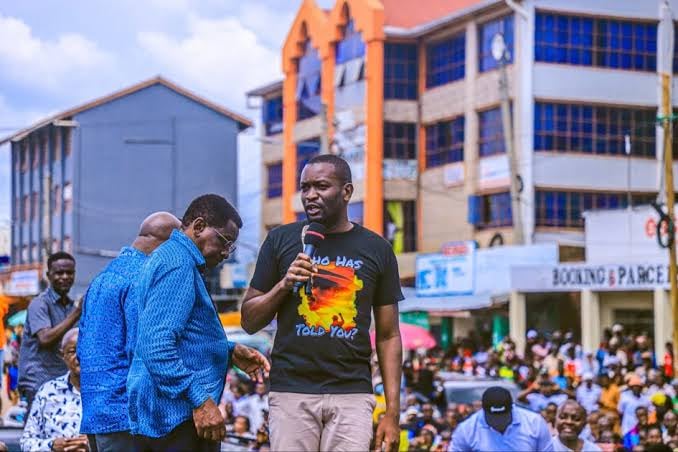
Weakness 1: Sifuna Is Currently Just a Flesh Without a Skeleton
Edwin Sifuna is currently the movement known as Linda Mwananchi. His voice, his charisma, and his television presence are what the movement is. Remove him from the equation, and the movement falls apart. You can liken him to the flesh, as the movement has no skeleton underneath. It has no structure that would keep the movement standing even if Sifuna went quiet for a month. Though Edwin Sifuna is the flesh of the movement that has no bones yet, he himself has no clear vision for the movement. He doesn’t know how to plan ahead, and he clearly has no contingencies whatsoever put in place.
Take the paybill he set up as an example. Take the paybill he set up as an example. Within twelve hours of going live, it had pulled in over five hundred thousand shillings from more than nine thousand contributors, with donations as small as a single shilling and Kenyans responding the way they only respond when they feel like they are finally being asked rather than told. Sifuna even turned down Francis Atwoli’s offer to raise a billion shillings for him, saying he would rather be indebted to ten million Kenyans who gave him ten shillings each than to one wealthy backer who wants something in return later.
All of that shows a man who understands optics and knows how to read a crowd. What it does not show is a man who understands sequencing, because before a single shilling was sent to the paybill number, nobody had built a framework to account for where it would go. There is no independent treasurer named anywhere, no published income and expenditure report, and no audit trail the public can actually check against what gets spent on rallies, transport, or logistics. The paybill sits under his own personal name, since Linda Mwananchi is not registered as a party and cannot legally hold an account of its own. A movement with an actual skeleton would have caught this before the paybill ever went live, since setting up a treasury function is basic administrative work that should happen automatically once real structure exists behind a campaign, not an afterthought bolted on once the money is already flowing in.
The reason this exposes a skeleton problem, and not just a corruption problem, is that setting up a treasury function before opening a paybill is exactly the kind of basic administrative groundwork a functioning campaign framework would have handled automatically, the same way it would have handled logistics, communications, and coordination. A properly built movement does not let its founder wake up one morning and decide to open a donation line without first routing that decision through people whose job is to think about governance structures.
Sifuna, being a man who sat as a member of the Senate’s County Public Accounts Committee and spent years attacking President Ruto’s government on corruption, is precisely the kind of person who should have caught this gap himself, and the fact that he did not says less about his honesty and more about how little scaffolding exists around him to catch these things before they become public liabilities. A paybill number is one of the simplest things a campaign can set up, and getting it half-baked, on a matter he has built his entire political brand attacking others over, says everything about how thin the skeleton underneath Linda Mwananchi actually is.
The gaps run wider than the paybill. Linda Mwananchi is still not a registered political party more than a year into its rallies, and even Sifuna’s own allies seem unsure who exactly the movement’s flagbearer will be, given that James Orengo has publicly hinted at a candidate “waiting in the wings” without naming who that is. A movement pulling crowds in Taita Taveta, Kakamega, and Trans Nzoia has no visible logistics team, no communications department, and no coordination structure holding the regional factions together beyond Sifuna’s personal charisma. That absence becomes dangerous the moment something goes wrong, and something always goes wrong in a campaign that runs long enough. Kenyan politics has seen allies switch sides at the worst possible moment before. There is nothing stopping someone close to Sifuna, Babu Owino included, from negotiating secretly with the other side and then leaking details of private conversations right when it would hurt Linda Mwananchi the most. A campaign with no crisis communications plan and no rapid response team has no way of surviving the moment such a betrayal lands, and that vulnerability traces back to the same root cause as the paybill mess: a movement that has grown faster than its skeleton has.
Weakness 2: Economic Naivety
Sifuna likes to talk about constitutionalism and “we the people” as though those ideas exist somewhere apart from roads, land, and food on the table. They do not, and treating them as separate is where his economic thinking falls apart.
Sifuna’s economic naivety is clearly demonstrated by his attack on affordable housing, as he cannot link the affordable housing projects to social justice that he champions. Land in Kenya’s most productive regions keeps shrinking as forests and bushland get cleared to build homes, and once a plot gets subdivided across two or three generations, what is left is often too small to feed the family sitting on it, let alone the wider market.
We can already see the impact of land subdivision in Western Kenya in the form of reduced agricultural output, which is being compounded by depressed rains. Actually, Western Kenya and North Rift are currently staring at the face of hunger, as their first-half-of-the-year agricultural output has withered amid shrinking farmland and rainfall that keeps arriving late or not at all. Kenya is heading into a period of high maize flour prices between September this year and February or March next year, driven in large part by these crop failures, and the regions taking the hit are the very ones that have historically fed much of the rest of the country.
With people facing the possibility of starvation in the coming months, it will be impossible to tell them that what they need is social justice when they can’t afford to eat, since a constitution has never filled an empty stomach and never will.
If Sifuna cared enough to consider the impact affordable housing could have on food security, he could have seen that these houses are meant to free up land, and the freed land can then be used for increased agricultural output, including afforestation that would help with rain catchment over time. Instead he treats the whole programme as a Ruto vanity project worth mocking on television, without once asking what happens to the thousands of acres a community could reclaim for farming if its members moved into properly planned, vertically built housing instead of spreading their homes across every available plot. That is the naivety worth naming: a man who wants to fix hunger and land injustice through slogans while dismissing the one policy tool actually capable of putting land back into food production.
Weakness 3: A Novice in Governance
Every Kenyan president besides Jomo Kenyatta walked into State House having already run a major arm of government before taking the top job. Daniel arap Moi served as vice president under Kenyatta for over a decade before succeeding him. Mwai Kibaki had also served as vice president under Moi, years before eventually becoming president himself. Uhuru Kenyatta had run both the Finance ministry and the Local Government ministry. Ruto spent years as deputy president under Uhuru before taking the presidency in his own right, giving him a front-row seat to the machinery of state for the better part of a decade. Jomo Kenyatta gets a pass because the country needed a first president from somewhere, and there was no precedent to measure him against. Sifuna has neither that kind of executive record nor Kenyatta’s excuse of being first, and his career so far has been built largely in television studios and Senate debates, not in running anything of real consequence at scale.
Looking beyond Kenya does not settle the question in his favour either. George Weah rode his fame as one of the greatest footballers Africa has produced into Liberia’s presidency in 2017, and he left office in 2023 widely seen as having failed to convert that popularity into competent governance, losing his reelection bid after a single term. Jimmy Morales in Guatemala followed a similar arc, going from television comedian with zero political background to president in 2015 on an anti-corruption platform, only to spend much of his term clashing with the very anti-corruption body meant to hold his government accountable, and leaving office under investigation over his own campaign financing. Michel Martelly in Haiti, a konpa singer known to fans as Sweet Micky, won the presidency in 2011 with over two-thirds of the vote, and his time in office ended amid the kind of political instability that has plagued Haiti for decades since. Jón Gnarr in Reykjavik stands out as the rare exception, since his comedian-led mayoralty actually left the city’s finances in noticeably better shape than he found them, but that outcome came from surrounding himself early with people who understood municipal administration, not from charisma alone.
Sifuna does not just lack governing experience at this scale. He also lacks the kind of local and international relationships that let a new leader walk into office with donor confidence, working coalitions, and credible standing to negotiate bilaterally with other heads of state from day one. Building that kind of network takes years of deliberate relationship building, not a single campaign season.
Bonus Weakness: Arrogance
Arrogance on its own is not automatically fatal in Kenyan politics; Raila Odinga, the man Sifuna is clearly trying to model his political persona after, carried plenty of it throughout his career and still built one of the most enduring political brands the country has seen. The difference is that Odinga’s arrogance came wrapped in decades of political scar tissue, coalition building, and personal sacrifice that gave people a reason to tolerate it. Sifuna has not banked that kind of credit yet, and several people close to the political scene have already started pointing out that his version of arrogance reads less like calculated confidence and more like a young man who has not learned when to hold his tongue.
The record backs this up. Nairobi County Assembly Speaker Beatrice Elachi’s ally Alfred Aladwa publicly cautioned Sifuna against what he called pride and arrogance when Sifuna opposed the Raila-Ruto alliance, drawing a direct comparison to Ababu Namwamba, the ODM secretary general before him who was removed from office in 2016 partly over the same accusations. Mumias East MP Peter Salasya called out Sifuna for political arrogance and elitism after Sifuna ridiculed him during a televised interview over a document Salasya had allegedly misread, telling Sifuna to take his condescension to the courts rather than to politics. Migori Senator Eddy Oketch accused him of arrogantly bragging that the party could not dictate his political associations, back when a section of ODM was pushing for his expulsion. Even a Standard newspaper column that was largely sympathetic to Sifuna’s rise still felt the need to warn him against what it called the curse of the brilliant, urging him to consult widely rather than assume he already knows more than everyone else in the room.
None of these incidents on their own would sink a political career, but taken as a pattern, they paint a picture of a man who treats disagreement as a personal insult and dismissal as a debating tactic. That is a manageable habit in a senator with a safe seat. It becomes a serious liability in a man asking for the trust of fifty million people, coalition partners who expect to be consulted rather than lectured, and international counterparts who will not tolerate condescension across a negotiating table.
None of these four weaknesses is fatal by themselves, and a man with genuine public goodwill still has time to correct course before officially declaring. But together they point to the same root problem: a man carrying real ambition without the systems, the economic depth, the governing record, or the temperament to carry that ambition through to State House. Fix the structure, sharpen the economic thinking, build the network, and rein in the arrogance, and the rest becomes manageable. Ignore all four, and his opponents will not even need to invent attacks against him, since he is already handing them the material himself.