China is increasing scrutiny of publicly traded firms that spin off units for separate listings, which may slow a key source of new deals.
Brazil's Luiz Inácio Lula da Silva, who once refused a cell phone, has changed his stance after a stunning election defeat, raising doubts whether it is too late.
Aliko Dangote, Africa's richest man, has launched a multi‑billion shilling push into Kenya after earlier setbacks under former President Uhuru Kenyatta, driven by a warm relationship.
A mentor of Kenya's leading legal figures, such as former Chief Justice David Maraga, felt no cause for celebration on the nation's Heroes Day.
"The Ukombozi Alliance has updated its deed, removing the clause that made the party leader the automatic presidential candidate and adding deputy party leader positions." Let's count.
Ukombozi Alliance changes its deed, scrapping clause making party leader automatic presidential candidate, adding deputy party leader positions.
52 Kenyans appear in US DHS “Worst of the Worst” initiative, a database of immigration arrests involving people with criminal histories.
EyeCare Partners closing a deal with creditors to sell assets and repay debt at a discount, after previous debt workout two years ago.
UK Chancellor John Healey preparing next budget expected to include higher levies on bank profits.
Kenya Airways partners with Art of Luxury to offer premium customers exclusive shopping and lifestyle experiences. We need to rewrite in own words, not copy.
Thirty‑three banks and two microfinance institutions paid a total of Sh205.58 billion in taxes for the 2025 financial year, marking a 5.53 percent increase over the Sh194.81 billion paid in 2024.
Kenya’s treasury bill auction received KES 28.83 billion in bids for a KES 28 billion offering, achieving a 103 percent subscription, with the government accepting KES 28.79 billion and yields moving higher.
Kenya Pipeline Company shares jumped 7.95 percent to KES 9.78, their highest level since April, after a rally lifted the price above the previous peak of KES 9.56.
Bloomberg Deals reports that a data‑center transaction encountered difficulties, Elon Musk’s combined Tesla‑SpaceX venture remains uncertain, and Qiagen has reached an agreement to be acquired.
Nearly 60 percent of chief executive officers intend to replace a member of their C‑suite within the next six months, with chief financial officers identified as the most likely positions to be changed.
Kenya has purchased the building that houses its High Commission in London for £16.25 million (approximately Sh2.8 billion), moving toward owning diplomatic properties to reduce rental expenses.
An additional 362,846 formal‑sector employees will be exempt from income tax under the current review, while earners above Sh50,000 will face higher rates.
Singapore’s private home prices recorded their strongest rise in nearly two years while rents also increased, signalling that the housing market remains buoyant despite a recent slowdown in sales.
A recruiter spent several months converting nearly twenty years of expertise into four autonomous AI agents, demonstrating the effort required to replace a small company's human workforce with artificial intelligence.
University of Nairobi has been declared technically insolvent after accumulating 20 billion shillings in debt, attributed to lower government funding, high operating costs and unpaid obligations such as staff pensions.
Treasury allocated Sh651 billion budget to extend standard gauge railway from Naivasha to Malaba, citing high financing costs for 369km line.
Kenyan banks dropped from Africa's fastest-growing lenders list in Financial Times ranking, partly due to stable shilling against dollar.
Musk contributed over $445 million to his super PAC this election cycle, becoming one of largest-ever contributors to such groups.
Yen reached over one-month high as tech stock selloff boosted demand for Japanese currency, government bonds and US Treasuries.
Citizen TV investigation revealed planning behind October 2, 2026 demonstration against Standard Media Group.
Dan Makenzi, son of Makenzi, said he was humiliated and suffered due to his father's actions.
Kenyan parliament has passed a bill removing the requirement for the Electoral and Boundaries Commission to livestream results as they are announced at polling stations, raising transparency concerns ahead of the 2027 election.
Kenya raised the budget for the Standard Gauge Railway extension from Naivasha to Malaba to Sh651 billion, up from Sh503 billion. The 369‑km line will be funded through revenue securitisation, with Sh619 billion from lenders.
The Kenya Kwanza administration has launched its flagship Affordable Housing Programme, targeting the construction of 250,000 homes each year, financed by a compulsory 1.5 percent housing levy deducted from employee pay slips.
SK Hyper is negotiating with major tech firms and investors to fund a $350 billion data‑center buildout, joining a global AI infrastructure rush despite concerns about future demand.
MP Bernard Kitur said the handshake between Sifuna and Gachagua is hopeless, describing both as rejected leaders who have been removed from their roles, one expelled from his party and the other ousted from Parliament.
Mark Zuckerberg has taken measures to preserve his controlling interest in Meta, structuring ownership to avoid California’s proposed billionaire tax and to prevent dilution of his shareholding.
Jaramogi Oginga Odinga Teaching and Referral Hospital has started modernization with infrastructure upgrades, new medical equipment and a plan for a Sh4.9 billion complex to become a teaching, referral and research centre.
Dr Christine Ombaka says opposition leaders are turning tribal, using tribal blocs to gather numbers in political contests.
Companies can now hedge against fluctuations in tungsten prices by using contracts offered on the Kalshi prediction‑markets platform.
An oil producer in Canada is proposing a new port on the northern British Columbia coast that could ship up to 250,000 barrels of crude per day, but the plan requires an exemption from the federal tanker ban.
Kenya placed fifth in the mixed team relay at the African Road Cycling Championships in Kisumu, while Uganda failed to finish the race.
A weather system described as a wrecking ball is expected to unleash severe conditions across Latin America, eastern and southern Africa, Asia and the Pacific.
The United Arab Emirates is providing a US$1 billion AI for Development programme to support African projects that apply artificial intelligence in education, agriculture and infrastructure.
Businesses previously overlooked by large direct lenders are now facing intense competition, and borrowers are emerging as the beneficiaries of the tighter lending market.
Operators of Germany’s idle nuclear sites are exploring conversion of the facilities into data centers while the decommissioning of reactors proceeds.
Kenyan banks have dropped from the Financial Times list of Africa’s fastest‑growing lenders, a shift attributed in part to the stability of the shilling against the dollar.
Kenya Transport Association and Northern Corridor Transit and Transport Coordination Authority have agreed to cut freight costs by promoting fuel‑efficient practices and better fleet management.
Across Africa, trust in leaders is being tested as governments face mounting financial pressure, trade disagreements with neighbours and demands for greater accountability, prompting difficult questions about governance.
The ongoing public university lecturers’ strike in Kenya is deepening a financial crisis that is forcing many needy students to abandon their studies, with some left with only a few months of funding.
Temasek president Png Chin Yee has been appointed to the board of directors of real‑estate asset manager CapitaLand Investment, expanding his role in Singapore’s property sector.
A new Women’s Pro Baseball League has been launched, ending a 72‑year exclusion of women from professional baseball and providing a platform for female athletes to compete at the highest level.
Former Kiambu Governor Ferdinand Waititu, his wife Susan Wangari and associate Charles Chege remain in remand custody while they await sentencing in a money‑laundering case.
The International Criminal Court received the European Union’s highest human‑rights award on Thursday, a gesture of support that could irritate President Donald Trump amid ongoing U.S. sanctions.
Visitors gathered at Egypt’s Abu Simbel temple on Thursday to observe a rare astronomical ceremony that has been performed at the site for millennia.
All 135 individuals identified as contacts of the recent Ebola case have been traced, and the first group of contacts who remain healthy will be released from quarantine after completing a 21‑day monitoring period.
The United States has identified fifty Kenyans among three thousand immigrants facing serious criminal charges and immigration violations, and has intensified deportation operations targeting those deemed highest threats.
DP Prof Kithure Kindiki condemned violence against Kawira Mwangaza and ordered that those involved be punished.
The National Assembly has approved the Elections Amendment Bill 2024, which may remove a requirement to livestream polling station results, raising concerns about transparency before the 2027 General Election.
Members of Parliament have accused the IEBC of excluding them from developing rules for campaign financing ahead of the 2027 General Election.
The Trump administration announced the removal of a blockade that had delayed several wind farms, aiming to strengthen backing for a bipartisan initiative to accelerate U.S. energy and infrastructure construction.
The developer of AT&T’s new global headquarters in Plano, Texas is pursuing roughly $3.5 billion of specialized financing to fund the construction of the expansive corporate campus.
Egyptian Foreign Minister Badr Abdelatty said on Thursday that every option should be considered to achieve a political settlement between Saudi Arabia and the Houthi movement.
Standard Chartered Bank announced that CEO Birju Sanghrajka has assumed leadership amid significant change and opportunity, noting that Kenyan customers seek banks offering sound advice, global reach and a wide range of products.
Kenya's health ministry reported that no new cases of Ebola (Bundibugyo Virus Disease) have been identified, and all 14 samples tested in the last 24 hours were negative as the outbreak response continues to make progress.
UK digital bank Revolut is expected to seek debt investment next year to build a buffer for potential losses according to a report from S&P Global Ratings.
Affirm is partnering with Walmart's Sam's Club as the retailer's exclusive buy-now pay-later partner weeks before the holiday shopping season begins.
Two people were kidnapped in separate incidents in Niger more than a year and a half ago while involved in education and development initiatives.
Member of Parliament Kuria Kimani said legislators learned much from the 2024 Finance Bill and that propaganda had convinced Kenyans the bill was bad without understanding it.
Kenya will face the United States tonight in the Under-17 Women's World Cup with the match broadcast on KBC Channel 1.
Deputy President Professor Kithure Kindiki urged Kenyans to maintain peace because they will remain neighbors after the election.
Ghanaian actor comedian and broadcaster Seth Kwame Dzokoto died at age fifty-one after collapsing during a live radio panel discussion at Owass Radio in Tarkwa Western Region on Thursday October twenty-two twenty twenty-six.
Member of Parliament Kuria Kimani stated that fuel prices would have risen further if value added tax on petroleum had not been reduced to eight percent noting that fuel taxes also fund road construction.
The cost of a thirty-second television advertisement spot has surged 2,600 percent reflecting the intensity of the Texas election campaign.
Authorities are reviewing licenses of alcohol manufacturers after seizing counterfeit alcohol worth 3.7 million shillings last month in Dagoretti North and Kariobangi areas.
The Vice President inspected projects in Tharaka‑Nithi County and opened construction of the Ksh7.5 billion Nithi Bridge, an 880‑metre long, 100‑metre high span designed to reduce road accidents.
Elon Musk has committed roughly one billion dollars to Skydance, providing a major capital boost to the newly created media and entertainment firm led by David Ellison.
Professor Noah Feldman argues that the chief issue with the Supreme Court’s conservative majority is not partisanship but public apathy toward the real‑world effects of its decisions.
French health authorities announced the first human case of the livestock‑borne Shamonda virus in a severely immunocompromised patient who died, and said no risk to the general public has been identified.
Protests over the cost of living have broken out across Europe and Africa; while Europeans demonstrate over housing, wages and services, Africans confront far steeper economic hardships and weaker social safety nets.
Police report that a foreign national was beaten to death by a crowd of about 50 people on a Durban roadside, where he was approached before the assault.
A new report highlights Paul Barril, a French operative, as a central figure in the Tutsi genocide in Rwanda.
The former governor who lost the 2023 race has joined the ADC party and says he will challenge the powerful political machine of President ABAT, believing he can achieve what previous candidates could not.
The International Criminal Court received the European Union’s Sakharov Prize despite facing U.S. sanctions, a move that could irritate President Donald Trump.
On 22 October 2026 Kenya Pipeline Company rose 7.9 % to 9.78, while Nairobi Business Ventures fell 3.8 % to 1.26, and Safaricom accounted for 55.5 % of total equity turnover in the session.
The U.S. Department of Homeland Security disclosed that 50 Kenyan nationals are among approximately 3,000 migrants facing serious criminal charges and immigration violations.
FIFA has opened the bidding process for United States television rights to the men’s World Cup tournaments scheduled for 2030 and 2034.
L’Oreal reported sales that exceeded expectations, driven by strong demand for salon hair products and premium skincare items.
County Commissioner Hussein Allaso issued an order preventing national government staff from saluting Trans Nzoia Governor George Natembeya, sparking a sharp dispute between the two officials over political neutrality.
Former presidential escort officer Michael Kimutai has spent six weeks searching for his missing wife Lily Cherono, who disappeared from their home in Kaplamai, Cherangany, Trans Nzoia County.
NTV Kenya will broadcast a new episode of The Power of Prophecy with Prophet Elvis Mbonye on Sunday at 9:00 AM.
Rising concerns over the Middle East conflict have pushed oil futures higher, putting pressure on markets and stoking inflation fears as the United States approaches its midterm elections in less than two weeks.
President William Ruto’s ten‑day tour of Kenya’s North Rift has revealed growing rivalries inside his United Democratic Alliance, as competing factions vie for his influence ahead of the 2027 general election.
Hotel101 Global, the international hotel chain backed by Jollibee founder Tony Tan Caktiong, will develop a 750‑room hotel in Cairo valued at approximately $102 million, marking the company’s first venture into Africa.
The International Criminal Court is receiving the Sakharov Prize as it confronts its most challenging period, marked by a damaging sex scandal, a loss of members and the prospect of severe U.S. sanctions.
Billionaire Jackie Reses, who recently acquired a bank, observes that fintech companies are beginning to follow the same acquisition path she pioneered.
The U.S. Treasury Department has proposed regulations that would prohibit large institutional investors from purchasing single‑family homes, advancing the implementation of a controversial provision of the bipartisan housing law.
In Ceuta, feelings of abandonment after the July migrant crisis are providing new momentum to right‑wing parties ahead of Spain’s general election scheduled for 29 November.
The Water, Sanitation & Irrigation Conference will take place on 22‑23 October 2026 at the Iconic Plaza Hotel in Nairobi, featuring speakers who will discuss Kenya’s water future as part of the Road to Abu Dhabi initiative.
Nairobi Governor Johnson Sakaja dismissed Geoffrey Mosiria as chief officer for public participation, citizen engagement and customer service, months after Mosiria announced he would run against Sakaja for governor.
Blackstone said its third‑quarter income fell as higher energy prices drove inflation and rising interest rates dampened deal activity.
Ecuadorian authorities arrested former presidential candidate Luisa González, linking her to a money‑laundering investigation.
France reported its first human infection with the Shamonda virus, previously known only in animals; the patient died earlier this month.
A recent assessment identified motorcycles as the primary means of moving wild meat across the Kenya‑Tanzania border.
Governor Natembeya urged County Commissioner Hussein Allaso to stop emotional displays and sycophantic praise, emphasizing that officials should advance through professionalism rather than flattery.
The finance ministry reported shipping $889 million of a precious metal during the month, a 68.9 percent increase from the same period last year.
Raffles Family Office will market Rwandan projects to its wealthy clients, aiming to raise several hundred million dollars over several years. Sectors include Formula One infrastructure, tourism, hotels, property and aviation.
The National Police Service and the Independent Policing Oversight Authority have launched separate investigations into the arrest of Citizen TV journalist Francis Odee in Nairobi.
Ugandan socialite Zari Hassan has generated online discussion after a video surfaced showing her kneeling to greet her husband.
Sony's PlayStation 5 unit sales in the United States rose 22% in September as consumers prepared for the upcoming release of Grand Theft Auto VI.
A mob of about 50 people beat a foreign national to death on Thursday in Durban, South Africa, a city known as a flashpoint for anti-migrant sentiment, according to police.
Kenya's latest Treasury bill auction drew KES 28.83 billion in bids against KES 28 billion offered, achieving a 103.0% subscription rate. The government accepted KES 28.79 billion, with accepted yields rising across all tenors.
The Employment and Labour Relations Court has nullified the January elections of the Kenya Union of Post Primary Education Teachers, or Kuppet, in Kiambu. The court ruled that the January polls were irregular.
Palestinians in Gaza face worsening humanitarian conditions. The United Nations had to reduce food assistance because of funding shortages, deepening food insecurity for thousands of families who depend on aid.
A Democratic state legislator in Virginia was charged over allegations of corruption and bribery related to marijuana dispensaries.
Czech policymakers are facing a difficult choice about whether to raise interest rates next month. They are considering a response to global pressures while trying not to increase market borrowing costs.
Owners of newly built hospitals report they have purchased equipment, hired staff and scheduled patients, but the Social Health Authority postponed contracts until January, preventing them from treating patients until next year.
Former Nairobi City County Chief Officer for Citizen Services Geoffrey Mosiria claims his removal by Governor Johnson Sakaja ends a three‑year dispute that began when his duties were taken away and his budget cut.
The United Nations warned that the present El Niño could become one of the strongest and most destructive on record, increasing the likelihood of extreme weather events and a sharp rise in global hunger.
A mob of roughly 50 individuals beat a foreign national to death in Durban, South Africa, police said, amid ongoing anti‑migrant protests that have sparked looting and violence in the city.
Barclays announced a reduction of 5,000 positions as the bank implements artificial intelligence to lower costs and improve efficiency, according to an explanation from Charlie Wells.
NHL legend Henrik Lundqvist appears on The Deal with former baseball star A. Rod to discuss fan expectations, his Rangers legacy, national broadcasting duties and the mental aspects of on‑ice errors.
President Emmerson Mnangagwa took over as chair of the 21‑member Common Market for Eastern and Southern Africa, pledging to give priority to local processing of natural resources.
Courts convicted preacher Paul Nthenge Mackenzie and 28 co‑accused of killing 190 children and one adult in the Shakahola fasting tragedy, and his son Dan said his siblings were forced to fast before police rescued them.
Benjamin Siele, chief executive of AGC Tenwek Hospital, balances his role with a passion for athletics, regularly training in tracksuits despite his earlier lack of sporting experience.
The High Court rejected a request to halt criminal proceedings against a 28‑year‑old man accused of forging vaccination certificates and vaccine stamps linked to Wilson Airport.
The United Arab Emirates has nominated foreign ministry official Lana Nusseibeh as its candidate for United Nations secretary‑general, as current contenders encounter obstacles in the Security Council.
President Ruto said he introduced an African investor to Zimbabwe’s President, and the investor intends to commit more than Ksh200 billion in investment in Zimbabwe.
Jimmy Wanjigi said insults show desperation and that his opponents lack a clear alternative agenda, noting the next election will focus on President Ruto versus Kenya’s economy, a challenge they are failing to meet.
He traveled to France for medical treatment two months after being released from prison following a presidential pardon.
Kenya aims to start crude oil exports from Turkana by December 2026, 14 years after the South Lokichar Basin discovery, but the timeline is uncertain because of financing, President William Ruto said.
The widow of former Vice‑President George Saitoti is opposing a court request by a man claiming to be his son who wants dig for DNA test; she says it would distress family, may not yield usable DNA and lacks proof of paternity.
The head of France's nuclear safety authority says EDF has options to keep its reactors operating beyond the current 60‑year design life.
New data shows that the deportation operation described by the Trump administration as the largest in U.S. history is not close to reaching its stated goal.
At the COMESA Summit 2026, President William Ruto said that ambitious plans require bold financing and that regional integration has become an economic and strategic necessity.
Kuria Kimani, chair of Parliament's Finance Committee, will face questioning tonight at 7 p.m. with Fred Muitiriri on oil prices, the 2024 Finance Bill, the burning of his house and 2027 political issues.
Small clubs are calling music giant Live Nation a monopoly and say it is crowding out competition. A judge may break it up.
A PCS Mudavadi said Africa's lack of a permanent seat on the United Nations Security Council remains a serious question of legitimacy.
President William Ruto said at the Comesa Summit 2026 that he will be fair in partnerships, firm in interests, open in markets, and reliable in his word.
President William Ruto said Africa does not ask to be treated as special and instead asks to be treated as equal.
President William Ruto said that shared prosperity is essential, noting that without it there is no true prosperity.
The average annual premium for family health coverage this year reached $28,303, representing a five percent increase over the 2025 level.
Vivek Ramaswamy is spending $4 million on a television advertisement that features the estranged mother of former health official Amy Acton, a move critics say may generate sympathy for Acton rather than votes for Ramaswamy.
Musalia Mudavadi said trust should not replace accountability and that societies should not gamble with people’s confidence by making promises that are not fulfilled.
A lawyer for neurosurgeon Leopoldo Luque claims he is being used as a scapegoat and rejects the suggestion that the player’s death could have been foreseen.
President William Ruto said COMESA’s economy grew to 6.4 percent in 2025, up from 5.6 percent in 2024, while inflation fell to 13.2 percent from 31 percent.
Kenya reported nine confirmed Ebola cases as of 20 October, while Nigeria recorded an imported case on the same day; officials say Kenya faces higher risk because of direct flights and larger passenger volumes than the DRC.
Foreign investors reduced their holding in KCB while Kenyan investors added Sh2.1 billion, after the bank’s shares rose 30.32 percent over the last six months.
Babu Owino argued that political discussion should focus on where a party is likely to lose an election rather than on strategies to win it.
President William Ruto stated that Africa’s trade model of exporting raw materials, importing finished goods and borrowing at a premium is no longer viable.
API Events will hold the Capital & Legacy Forum in Nairobi on 10 November at KOFISI Kaskazi, a one‑day meeting for family‑office directors, ultra‑high‑net‑worth individuals and their advisers.
Authorities said that without further transmission they can start a 42‑day countdown to declare the country Ebola‑free once required conditions are met.
The Rongai parliamentary seat in Nakuru County is shaping up as a contest between the Moi and Komen families seeking to unseat the current MP in the 2027 election.
A human rights activist from Eldoret appeared in court facing drug trafficking charges and denied the accusations.
Over 500 people in South Africa have fallen ill from a gastrointestinal illness causing stomach cramps and diarrhea. Authorities blame poor water quality in two different cities for the outbreak.
A second ship has delivered more equipment to the Dangote Refinery project in Lamu. The government says construction is progressing as scheduled and that ecology conservation will be undertaken.
Tanzania's CRDB Bank plans a 1.3 billion US dollar multicurrency bond programme for early 2027. The programme is over four times its earlier 300 million dollar programme.
Auditor General Nancy Gathungu wants public officers whose decisions cause taxpayer losses held personally liable. She said legal changes strengthened accountability but audit findings must lead to action.
EALA MP Winnie Odinga will contest the Nairobi Senate seat in 2027. This adds a new dimension to opposition talks as Senator Edwin Sifuna prepares to challenge President William Ruto.
BAT Kenya won its debt case against a distributor, with the High Court dismissing the distributor’s application and refusing to refer the matter to arbitration.
Norway’s $2.3 trillion sovereign wealth fund fell 0.5% in the third quarter, mainly due to losses in its fixed‑income investments.
A senior Tanzanian opposition official, John Pambalu, faces the death penalty after being charged with treason in Tanzania.
The Cargill dynasty, linked to Walmart heir Rob Walton, pledged $160 million to support Kenya’s wildlife, community livelihoods and tourism across 17.3 million hectares.
Mama Lucy Hospital denied negligence claims after a mother of three died during delivery, with its baby placed in an incubator while investigations continue.
Kenya confirmed nine Ebola cases and one death, urging better protection for health workers and adequate equipment, while Nigeria reported its first case in over a decade and officials stress presidential funding is vital.
Ruto said plans must be matched by adequate financing and that funding should sit at the heart of Comesa’s next phase deliberations.
Margaret Mbai, widow of Dr Crispin Odhiambo Mbai, was at a Kisumu hospital on Tuesday, October 20 caring for her elder brother when news of her husband’s posthumous recognition arrived unexpectedly.
Police in Kikuyu are investigating alleged assaults on women protesting illegal alcohol outlets in Thogoto, while Deputy Commissioner Charles Laboso condemned the attacks and promised action.
During the requiem mass for veteran diplomat Burudi Nabwera in Nairobi’s Lang’ata, a senator criticized recent high‑profile meetings and responded to accusations.
Investors are favoring 91‑day Treasury bills, betting that rising inflation will push interest rates higher.
A private investor can easily take control of a public asset through a rights issue that dilutes existing shareholders.
An aerial photo shows a stark contrast between gleaming high-rises and a nearby slum, with the location not identified.
The Nairobi city security department has implemented strategies to enhance security during the Standard Chartered Nairobi Marathon taking place this Sunday.
Transporting livestock to market has become more expensive due to higher fuel prices, while low government investment and livestock product losses are reducing herders' income.
CNP Assurances will focus on integrating its recent Latin American acquisitions for the next two to three years but is not ruling out future targets in the region.
Governor Natembeya told County Commissioner Hussein Allaso to stop emotional reactions and sycophancy, emphasizing that professionalism—not praise—should guide career advancement.
Controversial preacher Paul Nthenge Mackenzie and 28 others were convicted of murdering 190 children and one adult in Shakahola, marking a significant victory for justice.
CRDB Bank plans to raise approximately $1.3 billion through a multi-currency bond program starting Q1 2027, with notes in dollars, euros, and Tanzanian shillings to fund expansion.
As President Ruto campaigns for a second term, analysts question whether his promises will deliver real benefits to Kenyans or remain political rhetoric.
At COP17 in Armenia, discussions highlighted concerns over technology-free farming, inadequate storage facilities, and women's exclusion from decision-making in agriculture.
Critics say the government lacks transparency while farmers struggle with high production costs and unresolved challenges, raising questions about agricultural support effectiveness.
A family from Kangoya village is demanding justice after their 12-year-old son, Peterson Nene, drowned at Arbbor Hotel along Kamiti Road during a Sunday family outing.
Rescue operations continue at Mutonga River Stone Quarry in Igoji East, Meru County, after several people were trapped and are feared dead following debris collapse.
Alex Mwakideu expressed dissatisfaction with seating arrangements during a meeting held at Wamunyoro.
Djibouti has paid Kenya Sh129 million toward a five-year-old debt owed to KenGen, whose revenue from diversification dropped to Sh122.1 million in the year ending June 2026.
Billionaire Aliko Dangote has elevated his daughters Mariya, Halima, and Fatima to senior roles in his business empire, fueling speculation about future leadership succession.
European securities firms may face millions in daily penalties if they fail to resolve settlement inefficiencies before the region's accelerated trading schedule begins.
Embu Catholic Bishop Peter Kimani has urged aspiring leaders to obtain academic qualifications before seeking leadership positions.
President William Ruto’s 2027 re-election campaign is becoming a staging ground for leaders, including Prime Cabinet Secretary Musalia Mudavadi and National Assembly Speaker, who position for the 2032 presidential contest.
Ruto says he introduced an African investor to Zimbabwe's President, who plans to invest Ksh220 billion in Zimbabwe.
Japan's largest labor union federation will demand wage increases of about 6% during next year's pay negotiations.
China's state-backed iron ore buyer and Rio Tinto have signed a multiyear agreement for steel-making iron ore supplies.
Kenya’s National Bureau of Statistics reports that Nairobi’s middle‑income apartment price index fell to 86.4 in Q2 2026 from 87.4 a year earlier, while the index for areas outside Nairobi dropped to 111.6 from 121.4.
The Director of Public Prosecutions has charged a bus driver with twelve offences, including two counts of causing death by dangerous driving, after a fatal crash that involved Technical University of Mombasa students.
FKF President Hussein Mohammed said the Junior Starlets’ first World Cup match tested them, the second will define them, and urged the team to respond with resilience and bounce back stronger.
Belgium condemned the launch of former Congolese President Joseph Kabila’s new political‑military movement, describing the decision as deplorable, incomprehensible and unacceptable.
Jacob Kaimenyi, former Cabinet Secretary for Education, has been appointed the second chancellor of the Management University of Africa, succeeding Dr Reuben Mutiso.
Malaysia’s government‑backed navigation app TuJu, promoted as a Waze alternative, is attracting ridicule and memes due to numerous performance shortcomings.
The United States ordered several diplomats and their families to depart Saudi Arabia because of heightened threats from Houthi militants, who have intensified strikes from Yemen.
Analysis of CEO surveys since March 2026 shows companies are increasingly sacrificing profit margins, as purchase price growth consistently exceeds selling price growth.
Ghana announced a 21‑day monitoring period for travelers arriving from Ebola‑affected regions, strengthening surveillance to prevent importation of the Bundibugyo virus and ensure early detection.
Ward representatives in Embu County have accused Minister Geoffrey Ruku of politically threatening them for not supporting the government, saying they will not tolerate violations of political freedom.
A family in Embakasi is demanding an explanation after a mother of three died following childbirth at Mama Lucy Hospital.
Leveraged bets on Indian equities are set to record their first monthly decline since March, indicating that retail investors are reducing exposure as the speculative rally loses momentum.
Barclays announced it will cut 5,000 jobs as part of a cost‑reduction programme, noting that artificial intelligence is beginning to improve efficiency across the bank.
Kenya’s mineral exports reached Sh22.54 billion in the 2025/26 fiscal year, with soda ash and gold emerging as top royalty earners following Base Titanium’s exit from the sector.
Africa’s defining historical moments are now available for licensed use through Nation Vault, providing authentic visual archives for storytellers, publishers, researchers, and institutions.
From final preparations to key discussions on water policy, the Kenya Water and Sanitation UN Pre-Conference and Expo 2026 is taking shape in Nairobi, focusing on shaping the country’s water future.
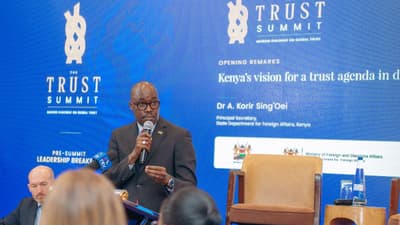
The Global Trust Summit 2026 is underway in Nairobi, gathering leaders, policymakers, and business executives to address institutional trust, governance reform, and global cooperation.
For over five years, Milcah Wambui lived with a man neighbors in Kirinyaga’s Rwambiti village described as loving and caring, making his alleged involvement in a brutal killing all the more shocking to the community.
The conviction of preacher Paul Nthenge Mackenzie and 28 co-accused for the murder of 190 children and one adult in Shakahola marks a significant milestone in seeking justice for victims of the deadly fasting regime.
Barclays equities traders exceeded expectations with a 47% increase in revenue, helping to offset a challenging period on the bank’s bond desk.
Rescue operations continue at the Mto Mutonga quarry in Igoji Mashariki, Meru, after several people were trapped following a landslide.
Experts note that while many young people have technical skills they often lack teamwork and time management abilities needed for success.
Nairobi Senator Edwin Sifuna defended his ties to DCP leader Rigathi Gachagua during a requiem mass and rejected claims that regional factors should guide political associations.
Nairobi County plans to build a large parking complex called Sunken Park to hold three thousand eight hundred slots instead of current two hundred forty.
Kenya's fish exports rose thirty-nine percent thanks to higher production levels and growing investor interest.
Moi Teaching and Referral Hospital placed one patient under twenty-one day Ebola monitoring after CEO Dr Phillip Kirwa announced the precautionary measure.
A recent assessment found motorcycles are the primary way wild meat moves between Kenya and Tanzania.
The London Stock Exchange Group agreed to buy credit intelligence firm Octus from Permira for three point five billion dollars in cash.
Paris Police banned protests in several city areas including near the presidential palace and Champs-Elysées citing risk of violence.
County Commissioner Hussein Allaso issued a directive barring National Government administrators from saluting Trans Nzoia Governor George Natembeya, triggering a bitter confrontation between the two county bosses.
President William Ruto toured his North Rift political backyard for 10 days, exposing simmering rivalries within his United Democratic Alliance ahead of the 2027 General Election.
A top Palantir executive said European countries need to acknowledge that some reliance on United States technology is inevitable.
Nearly one in three community health promoters surveyed in Nairobi and Kiambu reported symptoms of anxiety, while more than one in five reported symptoms of depression.
Sanlam Allianz Holdings Kenya has announced the retirement of Group CEO Dr. Nyamemba Patrick Tumbo effective October 31, 2026 after more than eight years in the role. Jacqueline Karasha will take over on November 1.
Unexpected DNA test results can challenge personal relationships, family history, and individual identity beyond biological confirmation.
Industrialist Narendra Raval has applied for a license to mine iron ore on 7,371 acres in Taita-Taveta County, aiming to establish the region’s first primary steel producer.
At the upcoming UN Water Conference in Abu Dhabi, emphasis will be placed on financing infrastructure to ensure water access as a fundamental right for all.
Turkish electronics maker Vestel Elektronik anticipates ongoing pressures leading to a major Eurobond restructuring, prompting a business model rethink.
Japanese companies including banks and airlines have suspended digital services to mitigate risks from software vulnerabilities.
Life insurance premiums in Kenya surged 34% to Sh147 billion in the first half of 2026, overtaking general insurance at Sh142 billion.
A 79-year-old retired teacher from North Rift counties became an internet sensation after her traditional dance video went viral during Mashujaa Day celebrations in Eldoret, showcasing rich cultural heritage.
An obituary notice has been issued for Eva Ngigi-Sarwari, Managing Director of Finserve Africa, a subsidiary of KCB Group.
SoftBank Group’s market value is set to halve from its June peak as higher borrowing costs have increased investor concerns about the sustainability of the company’s large artificial intelligence investments.
Mildred Cheche has urged her players to sharpen their finishing and defensive organisation as they seek to revive their campaign at the ongoing Fifa U-17 Women’s World Cup in Morocco.
Foreign investors sold 23.6 million KCB Group shares worth Sh2.1 billion at current market prices in the three months to September, while local investors increased their holdings.
Stakeholders from Kenya’s water, sanitation, and irrigation sectors are meeting over two days to discuss new technologies and practical solutions aimed at building a more water-secure future.
Angel Reese recorded three consecutive double‑doubles in her WNBA Finals debut, becoming the first player in league history to achieve that feat.
A Malindi man received a 30‑year prison sentence after being convicted of defiling a seven‑year‑old boy, according to the Office of the Director of Public Prosecutions.
Nigeria intends to launch an African depositary‑receipt system to boost cross‑border listings and draw more companies and investors from across the continent into its capital markets.
Bitcoin slipped below $83,000 on Thursday, erasing the previous session’s gains even as investors moved back into U.S. spot exchange‑traded funds.
Kenya’s borrowing from the World Bank has surpassed Sh2 trillion for the first time, with debt rising by Sh555 billion since President Ruto took office and Eurobond issuances increasing by Sh505 billion.
Kakuzi Plc warned that its 2026 net earnings will fall sharply below last year’s level, citing a weak macadamia market and a reduced harvest.
President William Ruto has signaled plans to reduce income tax for workers earning less than 32,333 shillings. He also proposed exempting certain land transactions from stamp duty.
Nigeria reports that its first Ebola patient in the current outbreak visited Uganda for two and a half weeks before returning via Ethiopia. Uganda states the patient only passed through after visiting DR Congo.
Nokia Oyj reported third-quarter profits that exceeded analyst expectations. The growth was driven by increased demand for data center networking equipment related to artificial intelligence infrastructure.
Twenty-one Italian companies have arrived in Kenya to pursue business opportunities within the local construction sector. This follows a 39 percent increase in trade between the two nations.
The Kenya Ports Authority is considering diverting vessel traffic to Lamu to manage rising cargo volumes at the Port of Mombasa. The authority may also increase automation to reduce congestion.
Indigenous communities at COP17 in Armenia are calling for the recognition of their rights and fair access to funding. They are seeking meaningful participation in biodiversity conservation efforts.
Shares of Kenya Pipeline Company rose by as much as 9.93 percent following Aliko Dangote's confirmation of a 24.76 percent stake acquisition and plans for a 1.5 billion dollar pipeline expansion.
First Lady Rachel Ruto has encouraged families affected by the Chesongoch mudslide in Elgeyo Marakwet County to rebuild. She participated in the handover of 53 houses to survivors of the tragedy.
New hospitals have stated they are ready to provide treatment but are waiting for contracts, as the extension of the Social Health Authority leaves them waiting until 2027.
Rwanda has been granted a ten-year contract to host a Formula One Grand Prix starting in the early 2030s. This marks the return of the sport to Africa after more than three decades.
Parents in Busia County are being encouraged to provide emotional and moral support to students sitting for the 2026 KPSEA and KJEA examinations to help create a calm environment.
The Ethics and Anti-Corruption Commission has recovered 12.57 million shillings from a Homa Bay assembly clerk and two other individuals. The funds were reportedly paid fraudulently from assembly salaries.
Deputy President Kithure Kindiki has identified illicit alcohol and drug abuse as major threats to the future of Kenya. He stated the government will introduce tougher laws and intensify operations.
Nairobi has entered the top five cities in the Oxford Economics Global Cities Index 2026 thanks to its financial hub status and strong innovation and demographic trends.
Investors surged into 91‑day Treasury bills anticipating rising interest rates as inflationary pressures resurface.
South Africa increased its borrowing requirement in the current fiscal year by 54.2 billion rand to fund a domestic bond buyback program aimed at smoothing redemption pressure.
Many chief financial officers are now prioritising tighter technology cost controls after giving teams broad budgets during the early adoption of AI and later facing surprise bills.
Skandinaviska Enskilda Banken has paused its share buybacks and reported its first quarterly results since chief executive Johan Torgeby stepped down earlier this month.
A former county accountant has lost Sh207 million in an unexplained wealth case involving EACC investigations conducted from 1 January 2013 to 31 October 2018.
University of Nairobi students marched along Uhuru Highway on Wednesday in solidarity with striking lecturers, demanding their pay and an end to a strike that has paralysed learning for nearly three weeks.
Airbnb will prohibit hosts from requiring guests to strip beds, wash dishes, remove trash offsite or impose their own fines, with the policy applying to new bookings from November 20.
President William Ruto is in Harare, Zimbabwe, for the 25th COMESA Summit, which focuses on regional integration, security, trade, industrialisation and adding value to resources.
IPOA is investigating the arrest of journalist Ode Francis during fuel protests on Mashujaa Day, with Chair Ojwang' saying police records are being examined to establish the circumstances.
Climate change and changes in land use are the biggest threats to wildlife because they alter the environment, while knowledge about their effects on tropical and subtropical bats, especially in Africa, remains limited.
Owners of newly built hospitals say they have purchased equipment, hired staff and booked patients, but the Social Health Authority’s postponement of contracts to January leaves them unable to treat patients this year.
The IMF warned that rising global interest rates could increase borrowing costs for governments, noting Kenya’s public debt of Sh1.7 trillion is due for repayment within a year, pressuring the Treasury to refinance.
HR managers report that many Gen Z candidates are ghosting employers after interviews, often citing better salary, shorter commute, flexible work, medical benefits and career growth as reasons for declining offers.
A Taita Taveta court sentenced a man to seven years in prison for trafficking wildlife trophies after finding four pangolin scales weighing 0.096 grams, valued at Ksh 300,000.
Former Kiambu Governor Ferdinand Waititu and two co‑defendants await a court ruling today in a dispute over sentencing in the KSh588 million graft case.
Mwala MP Vincent Musyoka Kawaya endorsed President William Ruto’s proposals on tax relief, affordable land, cheaper smartphones and expanded youth employment, urging the opposition to present an alternative.
Colombia’s president, Abelardo de la Espriella, replaced his interior minister after a budget setback raised doubts about his government’s ability to advance its fiscal agenda and reassure investors.
The Nature Conservancy announced that its Enduring Earth partnership has secured a $160 million conservation agreement in Kenya.
Aliko Dangote secured a 24.7% stake in Kenya Petroleum Company, becoming the second‑largest shareholder after the government and potentially gaining board seats, surpassing other major oil firms.
Djibouti’s state geothermal agency has agreed to pay Kenya Electricity Generating Company $1 million as the first instalment of a five‑year‑old debt from a geothermal drilling contract.
Kenyan families are spending large sums on exam papers to give their children an advantage in national tests, adding financial strain to households already struggling to meet basic needs.
Kenya’s hotel forward bookings rose to 59% for October and 56% for November, up from the previous year, while December bookings are expected to drop to 53%.
The United Nations special envoy for Sudan, Pekka Haavisto, together with Swiss officials, convened a new meeting of regional and global powers on Wednesday to develop a plan aimed at ending the war in Sudan.
Mainland‑listed Chinese stocks are poised to enter a technical bear market as fading expectations for major stimulus, weak earnings and ongoing concerns about the global artificial‑intelligence trade dampen investor sentiment.
Alibaba shares recorded their sharpest two‑month drop as investors reacted to Chinese regulators tightening product‑quality standards and enhancing consumer‑protection measures.
Nairobi County will construct a multi‑storey parking structure in the central business district with capacity for 5,700 vehicles per day, intended to reduce congestion and increase revenue from its third largest income source.
Dubai Investment Partners offered investors a total of $592 million in payouts over three years to stimulate demand for its Dubai‑based listing.
Chinese manufacturers are gaining market share across most product categories, demonstrating that the label Made in China can represent high quality.
Rajeev Pant, managing director of Prime Bank, opened the KenyaBankers series with a Q&A, urging entrepreneurs to answer three questions before launching: the problem they solve, who will pay, and how they will deliver.
Kenya’s state‑backed pension funds have cut their combined holding in Kenya Pipeline Company to under 15 percent after Aliko Dangote acquired a 24.76 percent stake in the firm.
The On the Green Course for the Green Cause will be held on 5 November 2026 at Royal Nairobi Golf Club, linking golf with climate action and offering sponsorship opportunities for brands.
With Brazil's presidential race effectively tied Luiz Inacio Lula da Silva and Flavio Bolsonaro are offering free public transport cash back on bills and debt forgiveness to win voters.
The UK government plans to remove standing charges on heating bills to lower costs for consumers according to Prime Minister Andy Burnham.
Political engagement between Gachagua's DCP and Sifuna's Linda Mwananchi is seen as a potential game-changer that could create a united opposition front or rival groups.
Graduation ceremonies have expanded to include Pre-primary Two learners with many parents spending thousands of shillings to mark the occasion.
Life insurance premiums surged 33.6 percent to Sh147.46 billion in the six months ended June 2026 surpassing general covers driven by retirement savings and investment-linked products.
Professor David Ndetei told the High Court his estranged wife and son allegedly threatened to reduce him to a street beggar as he opposed their bail release over the murder of his wife Doctor Victoria Mutiso.
Africa Centres for Disease Control and Prevention Director-General Jean Kaseya warned that if Ebola persists for another year it will become the worst health crisis the world has experienced.
Aliko Dangote has acquired a 25 percent stake in Kenya Pipeline Company for about Sh42.5 billion while state-backed institutions including the NSSF sold shares at Sh9.02 after buying at Sh9 making minimal profit.