African agriculture has many promising projects, yet the harder challenge lies in turning those projects into businesses that can survive once grants and pilots end. A leadership breakfast in Kigali on 30 September 2026 brought together representatives from business, government, development finance, philanthropy and agriculture at the Africa Food Systems Forum to examine how partnerships build durable food value chain systems across the continent.
The discussion centred on a simple principle: agricultural investment should begin with a credible market opportunity. That means establishing demand and offtake before capital is deployed, aligning incentives across the food value chain and ensuring that farmers can participate profitably. Public and philanthropic capital can then be used where it is most valuable: reducing early risk, strengthening infrastructure, building capability and helping promising models reach the point where commercial finance can take over.
Ethiopia offered one of the stronger examples of this approach in practice over the last two years. In 2024, the U.S. Government-funded Ethiopia Transforming Agriculture activity, implemented by RTI International, launched an initiative to increase potato production by strengthening market access through rural technologies in partnership with PepsiCo Foods Ethiopia and EUCORD. Today, more than 2,800 contracted farmers grow potatoes for PepsiCo; contract arrangements establish demand, quality requirements and pricing; seed multiplication addresses one of the food value chain's most persistent bottlenecks; and 84% of sourcing comes through the initiative.
For companies, stronger local food value chain systems can reduce supply uncertainty and create more stable operations over time. For farmers, the proposition is equally practical: better inputs, higher yields, reduced post-harvest losses and more predictable access to a buyer. Meghna Laxman, Corporate Affairs Director at PepsiCo Africa Franchise and Ethiopia/Nigeria Foods, said the real test is whether the farmer has a stronger business at the end of the partnership.
Participants argued that this commercial discipline should also change how development and philanthropic capital is deployed. Representatives from the Gates Foundation, African Development Bank, the Food and Agriculture Organization of the United Nations and the World Bank discussed the role of catalytic finance in absorbing risks that commercial investors cannot initially carry alone. These can include gaps in the food value chain, early-stage technology, farmer capability, currency and political risk, and the cost of developing new markets.
The longer-term objective, however, is not permanent subsidy or ongoing external support of any kind. The discussion highlighted a financing continuum in which philanthropic support is strongest when an idea is unproven, declines as the model becomes commercially established, and ultimately exits or assumes a narrower convening role once a venture becomes bankable. Meghan Anson, RTI's Senior Advisor for Food Security and Nutrition, said successful public-private partnerships create the greatest value when tied to a real market opportunity and when incentives are aligned across the food value chain.
A second Ethiopia initiative discussed in Kigali shows the potential scale of that approach. RTI brings together PepsiCo and partners including John Deere, Corteva Agriscience, Dimagi, Hello Tractor, Samanu and others to develop a domestic sunflower food value chain in Ethiopia. Leveraging American technology, this commercial partnership aims to reach 72,000 farmers across 43,000 hectares and generate $300 million in annual sunflower oil sales while expanding trade between the U.S. and Ethiopia.
The conversation also made clear that commercial demand alone is insufficient to build lasting agricultural markets on the continent. Roads, water, electricity, irrigation, extension services, finance and stable policy remain essential to making food value chain markets investable. Participants argued that governments and development institutions are therefore most effective when they establish the enabling conditions and public infrastructure around which private investment, technology and market access can grow.
That principle is now prompting conversations beyond Ethiopia and into other African markets where similar conditions apply. Participants discussed the potential adaptation of market-led food value chain models in Rwanda, including approaches that combine government-supported land and water infrastructure, private-sector anchor farms, training and patient financing for women and young farmers. One model under discussion would allow participants to repay the cost of greenhouse infrastructure from harvest revenues rather than servicing conventional loans before crops generate income.
Follow-up discussions are expected to examine how elements of the Ethiopia experience could inform future investment opportunities in Rwanda and other African markets, although no investment decision or formal Rwanda project commitment was recorded at the meeting. The wider challenge is now one of replication: identifying commercially viable agricultural opportunities, designing finance around the realities of farming and the food value chain, aligning public and private investment, and ensuring that the farmer remains an economic participant rather than simply a beneficiary. For Africa's food systems, that may ultimately be the difference between a successful project and a functioning market.
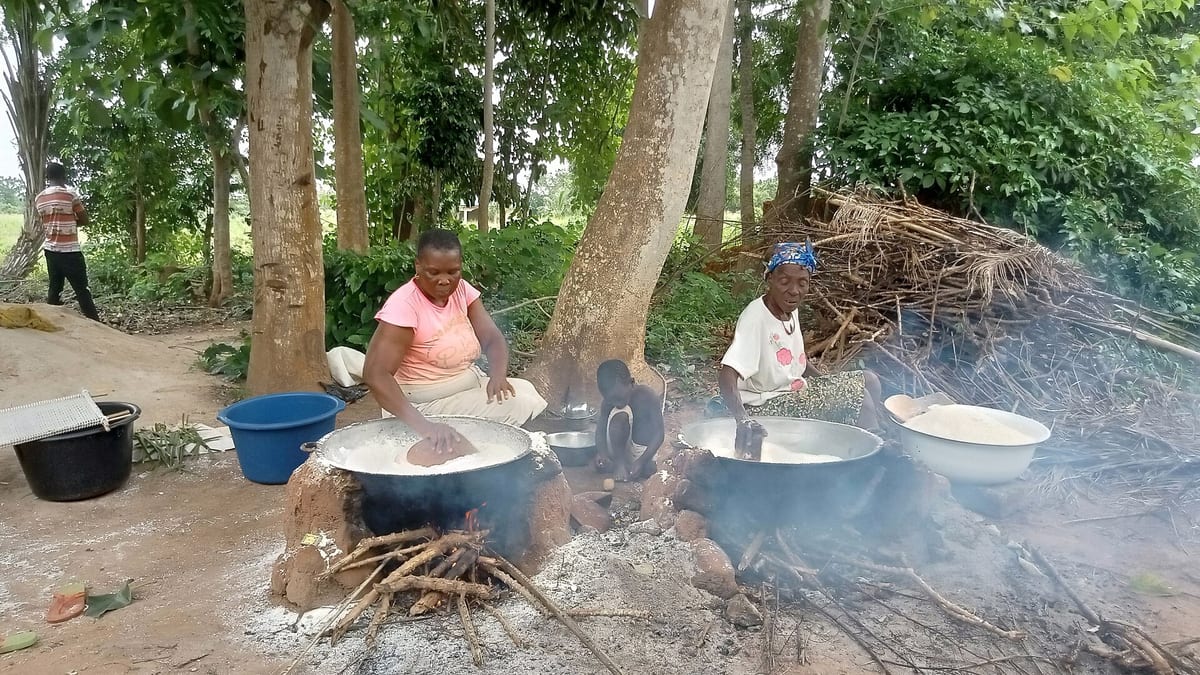
Image: Des femmes produisent de la farine de gari 06.jpg by Konouyawo, CC BY-SA 4.0, via Wikimedia Commons