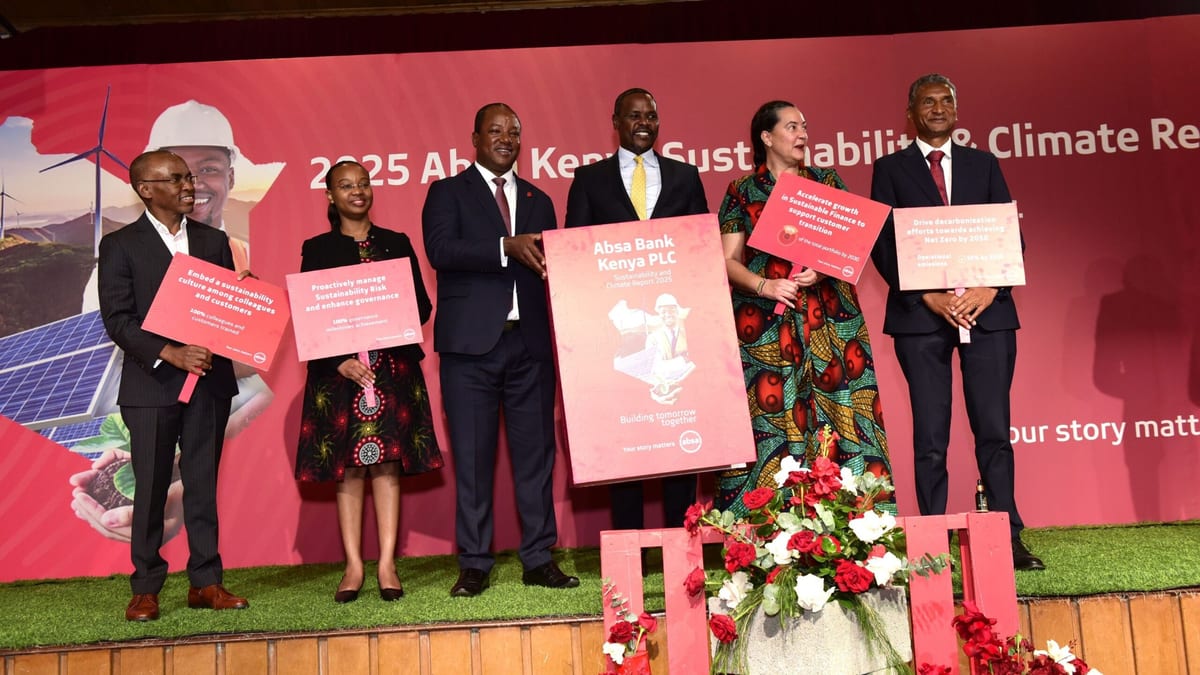
Absa Bank Kenya Advances KES 204 Billion in Sustainable Finance in Four Years, supporting financial inclusion, business growth, social development, and environmental sustainability across Kenya.
Between 2022 and 2025, the bank provided more than KES 204 billion in sustainable finance. In 2025 alone, Absa disbursed KES 55.3 billion, an increase from KES 47 billion in 2024.
Of the 2025 funding, KES 48.8 billion supported financial inclusion. This financing helped small and medium-sized businesses (SMEs), women-led businesses, young entrepreneurs, and communities that have limited access to financial services.
Another KES 6.5 billion went towards climate-related projects. These included renewable energy, green buildings, energy-saving projects, and climate-smart agriculture.
According to Absa Bank Kenya’s 2025 Sustainability and Climate Report, sustainable finance accounted for 30% of the bank’s total loan disbursements. This was significantly higher than the bank’s 10% target for 2025.
Speaking during the report’s launch at Strathmore University, Absa Bank Kenya Interim Managing Director and CEO Yusuf Omari said the bank remains focused on creating positive economic, social, and environmental impact.
He said Absa will continue working with customers, communities, government, and other partners to build a more inclusive, resilient, and sustainable future for Kenya.
Absa Strengthens Environmental Conservation
Absa also made progress in reducing its environmental impact. In 2025, the bank planted 283,969 trees, compared with 72,000 trees in 2024. This brought the total number of trees planted by the bank to more than 1.5 million.
The bank also recycled 96.4% of its waste and reduced its operational energy footprint by 41%, supporting its goal of achieving net-zero emissions.
Supporting Young People and Communities
Absa continued to invest in programmes that support young people, entrepreneurship, education, and community development.
Through the ReadytoWork programme, nearly 38,000 young people received employability and entrepreneurship skills in 2025. The programme has now reached more than 300,000 young people.
The Absa Kenya Foundation also expanded its work in education and skills development, entrepreneurship, and natural resource management, reaching more than 50,000 people during the year.
Dr Festus Ng’eno, Principal Secretary in the State Department for Environment and Climate Change, praised Absa for supporting climate action and sustainable development. He encouraged financial institutions, investors, and development partners to increase their support for green businesses, climate solutions, and sustainable infrastructure.
Stronger Climate Risk Management
Absa has also strengthened how it manages climate-related risks. Climate considerations are now included in business planning, lending decisions, and risk management.
The bank has also improved its sustainability reporting by aligning its disclosures with the International Sustainability Standards Board (ISSB) framework, including IFRS S1 and IFRS S2.
Absa’s New Sustainability Strategy
Looking ahead, Absa Bank Kenya has launched a new sustainability strategy built around four key pillars.
The first is to increase sustainable finance, with a target of directing at least 30% of gross loan disbursements towards financial inclusion, green finance, and nature-based finance.
The second focuses on achieving net-zero emissions by 2050 through measures aimed at reducing carbon emissions.
The third pillar focuses on improving sustainability risk management and governance, while the fourth aims to make sustainability part of the bank’s culture and improve the customer experience.
Absa says it will continue working with the government, businesses, development partners, and communities to finance projects that support Kenya’s long-term economic, social, and environmental development.
The full report is available in the Absa Sustainability Report.